Will Apple Silicon Macs Ever Depreciate the Way Intel Macs Did?
Intel Macs cratered on the used market. Here's why Apple Silicon has held value far better — and what could still bend the curve down.
Encore Editorial · Sep 4, 2026 · 6 min read
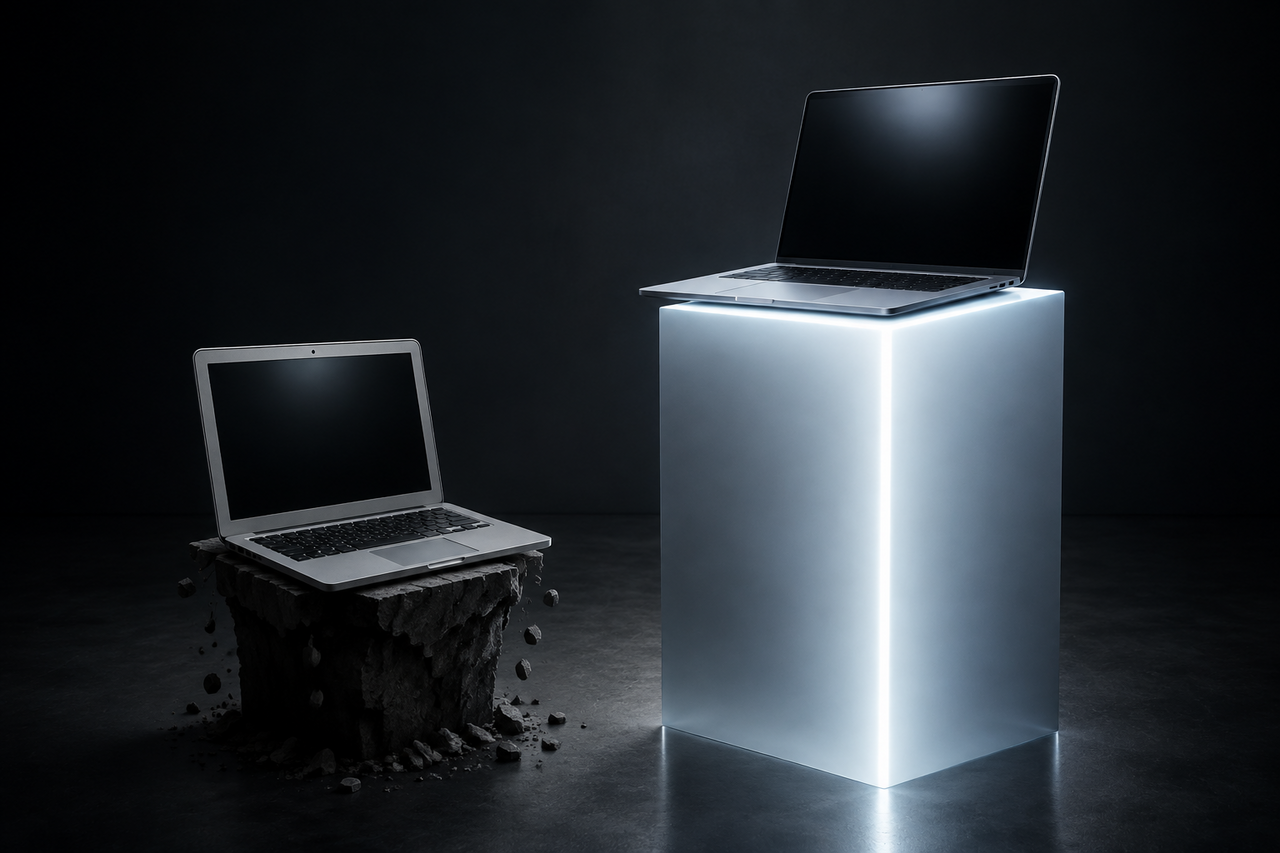
For most of the past decade, buying a Mac came with a quiet penalty: the moment you carried it out of the store it began shedding value, and an Intel MacBook a few years old was often worth a fraction of what you paid. Apple Silicon rewrote that expectation. The question worth asking now is whether M-series Macs will eventually depreciate the way Intel Macs did, or whether the 2020 transition permanently changed how these machines hold their value.
The short answer, drawn from resale data through 2026, is that Apple Silicon has held up dramatically better than Intel ever did. But "better" is not "forever," and there are specific forces that could still bend the curve back down.
How far Intel Macs actually fell
The Intel-era collapse was not gradual. When Apple introduced the M1 in November 2020, it reset what buyers expected from a laptop almost overnight, and the used market repriced Intel machines accordingly. The gap opened fast: the March 2020 Intel MacBook Air and the November 2020 M1 Air were separated by eight months on the calendar and a canyon on the resale sheet.
The high end fell hardest. A 2019 16-inch Intel MacBook Pro — once Apple's flagship — now changes hands for a small fraction of what it cost new, according to ValueSnap's tracking of real sold prices. Older 13-inch models from 2016 through 2018 often land near the bottom of the used market. In the resale data MacFinder compiled from six years of its own sales, that same 2019 Intel 16-inch shed up to 75% of its value by year two, and a 2018 Intel 13-inch was down roughly 75% by year three.
Why Apple Silicon has resisted the same fate
Apple Silicon Macs have followed a gentler slope. Gizmogo's analysis pegs M-series retention at roughly 55% to 75% of retail after one year and 40% to 60% after two — with Intel machines routinely falling below those ranges over the same window. Put in annual terms, ValueSnap estimates M-series MacBooks depreciate about 15% to 20% per year against 25% to 35% for Intel.
The reasons are not mysterious. M-series chips deliver performance-per-watt that Intel laptops simply cannot match, run cooler, last longer on a charge, and — crucially — stay on Apple's software support list longer. Buyers know all of this, so demand for used M1, M2, M3, and M4 machines stays high. The durability shows up at the far end of the curve too: MacFinder found a 2020 M1 MacBook Air still holding around 29% of its original value after five years, a figure most Intel models never approached.
There's a demand-side story underneath the specs, too. A used M1 or M2 machine isn't a compromise purchase the way an aging Intel laptop was — it's a fully capable computer that happens to be cheaper than new, which draws in students, small businesses, and refurbishers who all compete for the same inventory. That competition is what keeps prices firm. An Intel Mac, by contrast, increasingly reads as a stopgap, and stopgaps don't command premiums.
The takeaway: The Intel collapse was driven by a genuine generational leap, not ordinary aging. Because nothing on the horizon rivals the M1's jump over Intel, Apple Silicon is very unlikely to fall off the same cliff — but it will still depreciate.
What could still drag M-series values down
Resilient is not immune. A few forces could steepen the Apple Silicon curve over the next several years:
- The software-support cliff. Intel values didn't crater only because the M1 was faster — they cratered because Apple started winding down support. macOS Tahoe is the last release that will run on Intel-based Macs, and Apple has told developers they can drop Intel entirely. The same clock will eventually start ticking on the earliest Apple Silicon chips; when it does, expect a similar late-life slide.
- Base configurations aging faster. Not every M-series Mac ages equally. Entry-level 8GB machines are already depreciating faster in 2026 as AI features and heavier software make limited memory feel cramped, while higher-memory configurations hold firm.
- The next real leap. The one thing that reliably resets a used market is a step change buyers can feel. If a future chip or design delivers an M1-scale jump, older Apple Silicon could take a sharper hit than its gentle curve so far suggests.
For now, the practical implication runs the other way. Apple Silicon's slow depreciation means an M-series Mac you bought a couple of years ago is probably worth more than the "it's old now" math in your head assumes — and the smoothest part of the curve is exactly when many owners write the machine off. If you're weighing whether to hold or move on, it's worth a moment to see what yours is actually worth today before the next support cycle nudges it lower.
The bottom line
Will Apple Silicon ever depreciate the way Intel did? Not in the near term, and probably never as violently. The Intel drop was the product of a once-in-a-decade architecture change layered on top of a shrinking support window — a combination that isn't repeating soon. M-series Macs still lose value with age, and older or under-specced ones will fade as macOS eventually moves on. But the era of a three-year-old Mac being nearly worthless ended with Intel, and the data through 2026 says it hasn't come back.
Get an instant offer on your Mac
A real number in about 30 seconds — working or not. Free prepaid shipping, no seller fees, paid the day it arrives.*
Get my offerSources
- Gizmogo — M-Chip vs Intel MacBook: Which Models Hold More Resale Value?
- ValueSnap — MacBook Resale Value by Year (2026): Real Sold Prices
- MacFinder — How MacBooks Really Depreciate (Based on 6 Years of Our Own Data)
- AppleInsider — Developers can stop supporting Intel Macs, says Apple
- iGadgets Buy — MacBook Resale Value by Model: M1, M2, M3, and M4
More from Encore
 Value & Depreciation
Why MacBooks Hold Their Value Better Than Windows Laptops
Long software support, durable build, ecosystem pull, and steady demand keep used MacBooks worth far more than Windows laptops.
Sep 27, 2026 · 6 min read
 Value & Depreciation
Mac Studio vs Mac Pro: Which Holds Value Better?
Same silicon, very different depreciation: why the Mac Studio resells easily and the Mac Pro gives back more of its value.
Sep 27, 2026 · 6 min read
 Value & Depreciation
The iMac Pro: An Orphaned Powerhouse's Second Life
Discontinued, now Intel-sunset, still capable: who the iMac Pro is for in 2026 and how to value one.
Sep 27, 2026 · 6 min read