Mac Studio vs Mac Pro: Which Holds Value Better?
Same silicon, very different depreciation: why the Mac Studio resells easily and the Mac Pro gives back more of its value.
Encore Editorial · Sep 27, 2026 · 6 min read
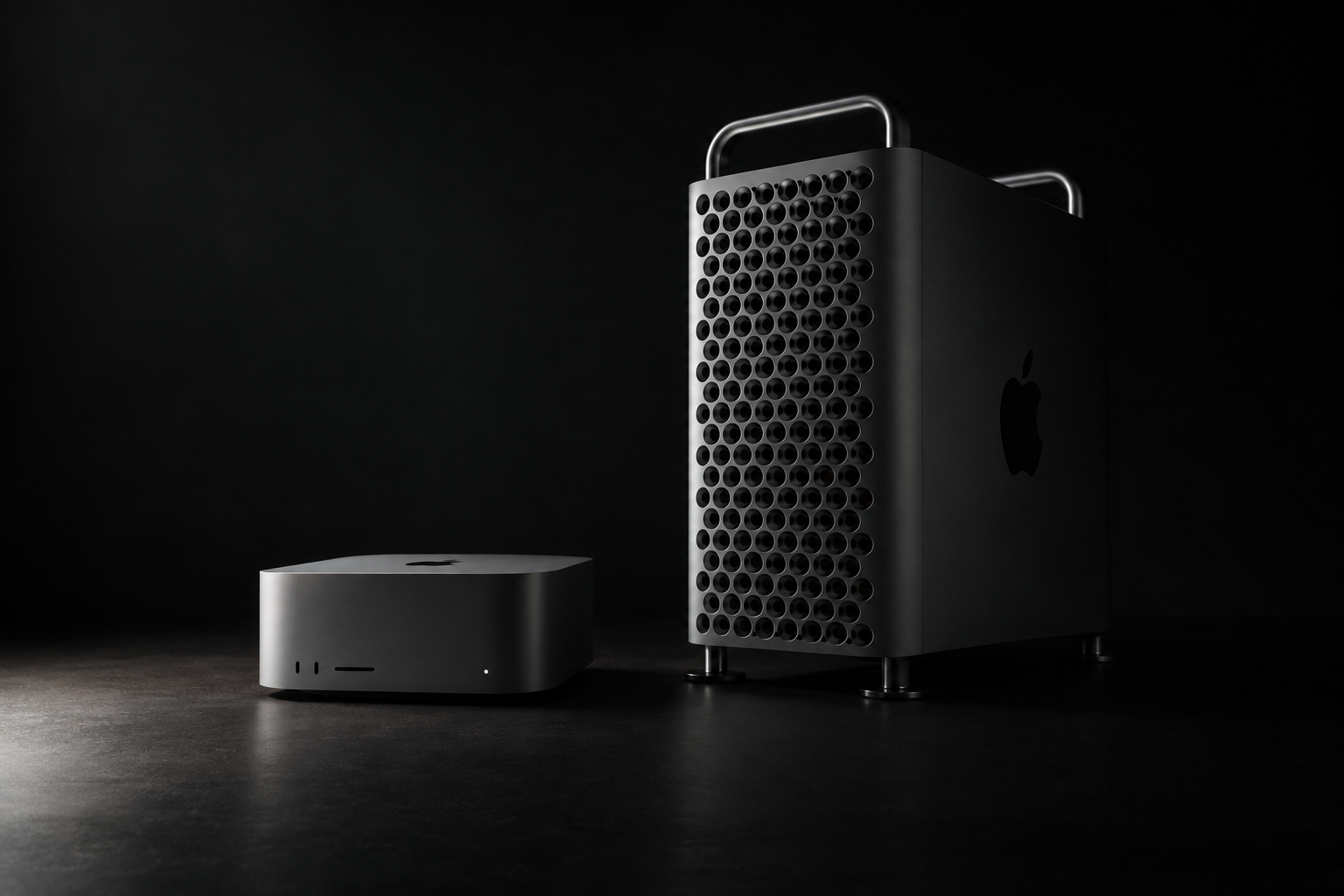
The Mac Studio vs Mac Pro question used to be about raw capability. Since Apple Silicon collapsed the performance gap between the two, it has quietly become a question about money — specifically, which one holds its value better over the years you own it. With Apple shipping a new M5 Max and M5 Ultra Mac Studio on September 22, 2026, and the Mac Pro sitting untouched on its 2023 chip, that comparison is worth doing carefully. The two desktops depreciate in very different ways, and the reasons say a lot about who should buy which.
Same power, very different boxes
Start with what the two machines actually are, because it frames everything about resale. When the Apple Silicon Mac Pro arrived, reviewers noticed it shared its top chip with the far smaller Mac Studio. As iMore put it, the Studio had "the exact same chip as the Mac Pro, same maximum 192GB of RAM and same 8TB storage option," and "the only significant difference is the Mac Pro's PCI expansion slots." The Pro's other distinction was size — the review noted it is "several orders of magnitude bigger than the Mac Studio."
That gap has only widened. Apple's newest Mac Studio, announced August 25, 2026, scales to a 36-core CPU and 80-core GPU with up to 512GB of unified memory, and Apple bills it as "the ultimate desktop for on-device AI and the world's most demanding pro workflows" in a design that "lives right on a user's desk," per Apple's newsroom. The Mac Pro, meanwhile, still runs the older M2 Ultra it launched with in 2023, and Apple's M5 Mac Studio announcement, as AppleInsider noted, made no mention of the Mac Pro at all.
The short version: The Mac Studio holds value better in practical terms — it's in constant demand and easy to resell — while the Mac Pro depreciates harder because it costs far more up front and appeals only to the narrow group that truly needs PCIe expansion.
Why the Mac Studio holds value well
The Mac Studio has become the default professional desktop for most people who don't need a laptop, and broad demand is the single biggest thing propping up any used price. A machine that thousands of people actively want is a machine you can sell quickly and without deep discounting. Several factors reinforce that:
- It's the obvious choice. With the same silicon as the Pro in a fraction of the space, the Studio is what reviewers repeatedly recommend for anyone who doesn't specifically need expansion slots. That consensus keeps secondhand demand deep.
- Apple Silicon ages slowly. M-series desktops stay fast and fully supported for years, so a two- or three-year-old Studio is still a genuinely current-feeling machine rather than a compromise.
- Fixed, premium specs travel with the unit. Because unified memory and storage can't be upgraded later, a Studio that shipped with generous RAM carries that value permanently — well-specced units resell for a clear premium over base ones.
There is one catch. The Mac Studio now gets refreshed on a fairly regular cadence, and each new generation steps the previous one down a notch. Depreciation tends to arrive in jumps at those launch moments rather than as a smooth glide, so the timing of a sale matters more for a Studio than for a machine that rarely changes.
Why the Mac Pro depreciates harder
The Mac Pro's value story is almost the opposite. It started at a dramatically higher price for hardware that, chip-for-chip, matched the much cheaper Studio. That large premium is the first thing the used market discounts, because a second-hand buyer is paying for capability, not for the empty chassis space that justified the sticker. The result is steeper depreciation in relative terms, even when the machine is barely used.
Its saving grace is also its limitation: the Mac Pro is the only Apple desktop with internal PCIe expansion, which is essential for a small set of workflows — high-end audio interfaces, specialized capture and I/O cards, extra internal storage arrays. That niche keeps a floor under used prices, because the people who need slots have nowhere else to go. But a floor built on a narrow audience is a thin one. Fewer buyers means longer time-to-sell and less negotiating leverage than a Studio owner enjoys.
The long gap between updates cuts both ways. Because the Mac Pro hasn't been refreshed, the 2023 model is still technically the current Mac Pro, which slows the psychological "it's old now" discount that hits the Studio at each launch. But an un-updated flagship also reads as an abandoned one to some buyers, and that uncertainty about the product's future is its own drag on confidence and price.
What this means if you're deciding
For resale purposes, the guidance is fairly clean:
- If you don't need PCIe slots, the Mac Studio is the better value both to own and to eventually sell. It costs far less for the same performance and moves quickly on the used market.
- If you genuinely need expansion, the Mac Pro earns its place — just go in knowing you're absorbing a larger depreciation hit for that capability, and that reselling will take longer.
- Buy the spec, not the box. On either machine, the memory and storage you order are locked in for life, so a thoughtfully configured unit protects your resale far better than a bare-bones one.
- Mind the calendar. Apple's roadmap points to continued Mac Studio chip updates, so selling ahead of an expected refresh — rather than right after one — protects more of a Studio's value.
When you're ready to move either desktop, the fastest way to see what your exact configuration is worth today, without wading through stale listings, is to get a real offer in about thirty seconds.
The bottom line
In the Mac Studio vs Mac Pro value contest, the compact machine wins for almost everyone. The Mac Studio's broad demand, slow-aging silicon, and easy resale make it the stronger value to own and to sell, with the main caveat being that its value steps down at each new-chip launch. The Mac Pro holds a narrow, durable niche for expansion-dependent pros, but its high entry price and thin buyer pool mean it gives back more of its value over time. Match the machine to your actual workflow, buy the configuration you'll want years from now, and time your sale before the next refresh rather than after it.
Get an instant offer on your Mac
A real number in about 30 seconds — working or not. Free prepaid shipping, no seller fees, paid the day it arrives.*
Get my offerSources
More from Encore
 Value & Depreciation
Why MacBooks Hold Their Value Better Than Windows Laptops
Long software support, durable build, ecosystem pull, and steady demand keep used MacBooks worth far more than Windows laptops.
Sep 27, 2026 · 6 min read
 Value & Depreciation
The iMac Pro: An Orphaned Powerhouse's Second Life
Discontinued, now Intel-sunset, still capable: who the iMac Pro is for in 2026 and how to value one.
Sep 27, 2026 · 6 min read
 Value & Depreciation
The MacBook Retina Era: What Still Has Value
As Golden Gate ends Intel support, here's which Retina MacBooks still sell and which have aged into donation territory.
Sep 27, 2026 · 6 min read