Repairability and What It Means for Resale
Soldered memory, glued-in batteries, and parts pairing make modern Macs hard to fix or upgrade — and that quietly reshapes what your machine is worth and who wants to buy it.
Encore Editorial · Sep 10, 2026 · 6 min read
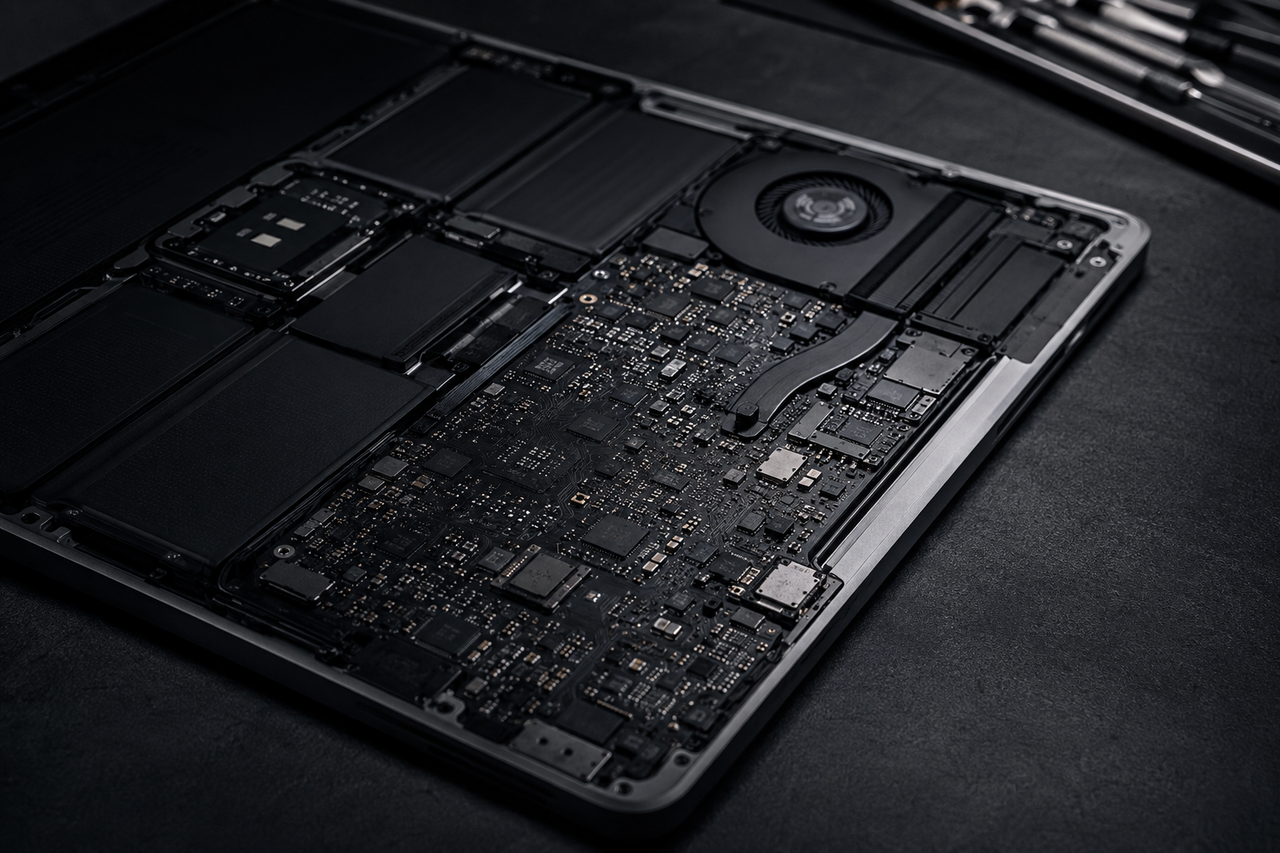
Open up a modern Mac — carefully — and you'll notice how little of it is meant to be touched. The memory is soldered to the logic board. The storage often is too. The battery is glued into the chassis, and many components are cryptographically tied to the specific machine they shipped in, so swapping a part isn't as simple as bolting in a replacement. For everyday use, that tight integration is part of why these machines feel so solid. For repair, upgrade, and ultimately resale, it changes the rules in ways worth understanding before you sell.
Why modern Macs are hard to repair or upgrade
Three design choices drive most of it. First, soldered memory and storage mean the configuration you bought is the configuration you keep — there's no adding RAM later, so the spec is fixed for the life of the machine. Second, adhesives and dense packaging make routine service, like a battery replacement, a delicate job rather than a five-minute swap. Third, parts pairing ties certain components to the individual Mac, so even a genuine part pulled from another unit may not work fully without Apple's own configuration step.
The counterintuitive result is that these hard-to-repair machines also last a remarkably long time. As BGR reported, well-kept refurbished MacBook Pros are so durable that they're cannibalizing sales of new laptops — a machine several years old still handles real work, so buyers happily choose a refurbished unit instead of the latest model. Longevity is great news for a seller: your older Mac is probably more desirable than you assume.
Hard to repair doesn't mean hard to sell. Because Macs are built to last and the parts inside are fixed, a clean, fully functional used machine is worth defending — its value comes from being complete and working, not from being upgradeable.
How repairability shapes resale value
Once you can't upgrade a machine after the fact, the original configuration does all the work in the used market. A Mac that shipped with generous memory and storage stays desirable for years, because a buyer can't cheaply add either later — they have to buy the tier they want up front, new or used. A base-spec machine is still sellable, but it competes on price rather than on headroom. In other words, repairability limits create a clear pecking order: complete, higher-spec, unmodified Macs hold value best.
The economics got a further push in 2026. As Prime Tech Support documented, Apple raised MacBook prices this year, so the new machine a buyer is comparing against costs more than it used to. When new gets pricier, a good used unit looks like an even better deal — which supports resale prices across the board, including for older configurations that would normally have depreciated faster.
What buyers actually care about
- Does it work fully? Because component-level repair is hard, a machine with no functional faults is disproportionately valuable.
- Is it complete and unmodified? Original, paired parts avoid the compatibility gotchas that come with mixed components.
- What's the fixed spec? Soldered memory and storage can't grow, so the tier it shipped with is the tier forever — and buyers pay for it.
- Is it clean and unlocked? This is the one that quietly destroys value, and it deserves its own section.
The activation-lock trap
There's a repair-and-resale problem that has nothing to do with soldering and everything to do with software. If a Mac is still tied to a previous owner's Apple account — Activation Lock is engaged — it can't be set up, resold, or refurbished by anyone else. As Fight to Repair has documented, activation locks send perfectly working MacBooks to the trash, because a physically flawless machine that can't be unlocked has no path back into use. That's the darkest edge of the parts-pairing philosophy: the hardware is fine, but the machine is effectively bricked to a refurbisher.
The takeaway for a seller is simple and empowering: before you list or ship anything, sign out of your Apple account, turn off Find My, and erase the machine. A clean, unlocked Mac is a functioning asset; a locked one is landfill. If you can't complete those steps because the Mac won't boot, that's worth flagging up front rather than discovering it after a sale falls apart.
Selling a machine that's easy to own but hard to fix
Put it together and a picture emerges. Modern Macs are built to be used, not tinkered with, which makes them durable and desirable secondhand — but it also means their value hinges on being complete, working, and properly unlocked, not on being upgradeable. That's a subtle thing to price yourself, especially if the machine has a fault or you're unsure whether it's fully signed out.
This is where selling to a dedicated buyer earns its keep. With Encore you get an instant online offer in about 30 seconds, a free prepaid insured label, and payment once the Mac arrives — the offer you accept is the offer you're paid. Crucially, Encore buys broken and damaged units too, so a machine with a repair problem the used market usually shuns still has a straightforward path to a fair offer instead of the trash. It won't always beat a perfect private sale on headline price, but it removes the guesswork about what a hard-to-repair Mac is really worth. If you're staring at an aging or imperfect machine and wondering whether it's even sellable, it's worth seeing what it's worth as-is before you write it off.
Get an instant offer on your Mac
A real number in about 30 seconds — working or not. Free prepaid shipping, no seller fees, paid the day it arrives.*
Get my offerSources
More from Encore
 Value & Depreciation
Why MacBooks Hold Their Value Better Than Windows Laptops
Long software support, durable build, ecosystem pull, and steady demand keep used MacBooks worth far more than Windows laptops.
Sep 27, 2026 · 6 min read
 Value & Depreciation
Mac Studio vs Mac Pro: Which Holds Value Better?
Same silicon, very different depreciation: why the Mac Studio resells easily and the Mac Pro gives back more of its value.
Sep 27, 2026 · 6 min read
 Value & Depreciation
The iMac Pro: An Orphaned Powerhouse's Second Life
Discontinued, now Intel-sunset, still capable: who the iMac Pro is for in 2026 and how to value one.
Sep 27, 2026 · 6 min read