Mac mini Resale Value, Generation by Generation
What a used Mac mini is worth in 2026, from the 2018 Intel model to the redesigned M4 — and the specs that move the price most.
Encore Editorial · Sep 6, 2026 · 6 min read
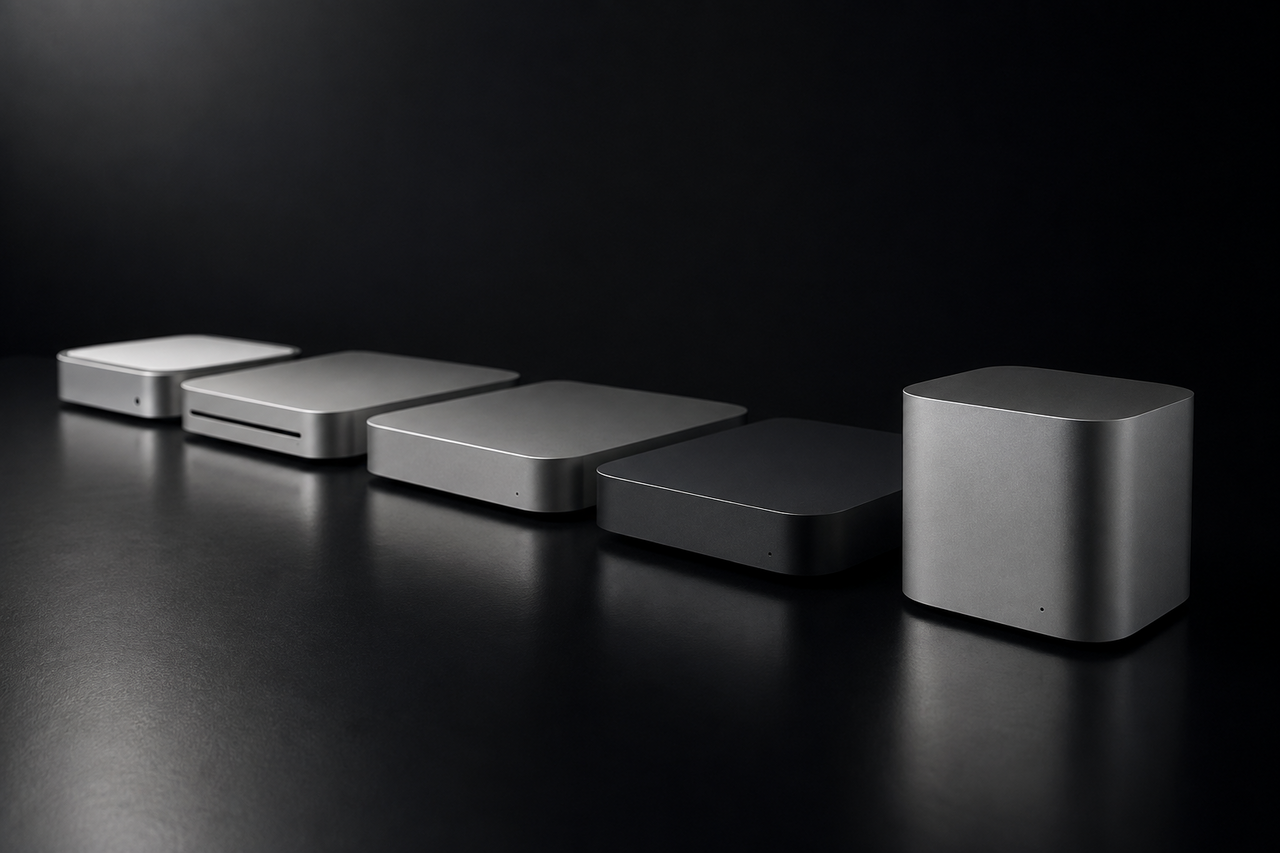
The Mac mini has always been the quiet value play in Apple's lineup — no screen, no keyboard, no battery to wear out, just the chip and the ports. That same restraint is why Mac mini resale value tends to hold up better than most Apple desktops: there are fewer parts to break, buyers span everyone from first-time switchers to developers running home servers, and demand for cheap, silent Apple Silicon has only grown. If you own one and are wondering what it's worth in 2026, the honest answer depends almost entirely on which generation you have and how it's configured.
Below is a generation-by-generation look at where used prices actually sit right now, drawn from live marketplace data, plus what pushes a given mini toward the top or bottom of its range.
Mac mini resale value at a glance
Here is roughly how the generations stack up against one another, based on real-world sale data from used-market price trackers as of September 2026, which report both listing and completed-sale prices by configuration. Think of it as relative standing, not a fixed quote — condition, storage, and RAM move each machine substantially within its band.
| Generation | Chip | Where it sits in the market |
|---|---|---|
| 2018 | Intel Core i3–i7 | The floor — modest and still slipping |
| 2020 | M1 | Strong for its age; outsells same-era Intel comfortably |
| 2023 | M2 / M2 Pro | A clear step up, with M2 Pro reaching workstation money |
| 2024 | M4 / M4 Pro | Top of the range; a maxed M4 Pro leads by a wide margin |
The pattern in one line: the jump to Apple Silicon reset the whole curve. An M1 mini from 2020 still resells for more than a same-age Intel mini, and higher-RAM, higher-storage, and Pro-chip configurations command dramatically more than their base siblings.
2018 Intel mini: the floor
The 2018 mini was a genuinely good machine in its day — the first mini in four years, with proper quad- and six-core Intel chips. But it's now the odd one out. It can't run the newest macOS releases as smoothly, it's the last mini that isn't Apple Silicon, and buyers know it. Resale trackers put most i3 and i5 units in the low tier — an i3/256GB near the bottom of the market and an i5/256GB a little above it, with well-specced i7 configurations climbing meaningfully higher.
The exception is memory. The 2018 was the last mini with user-upgradeable RAM, so a unit that's already been bumped to 32GB or 64GB is worth noticeably more to the buyers who want a cheap, expandable home-lab box. If yours is a base i3 with 8GB, it's near the bottom of the market; if it's a maxed i7, it holds a surprising amount.
M1 (2020): the value champion that won't quit
The M1 mini is the machine that rewrote the mini's reputation. It delivered performance that embarrassed the Intel model while running silent and sipping power. Nearly six years on, it remains the most affordable way to get into Apple Silicon, and its resale value reflects that stubborn demand.
Base 256GB units anchor the range, with each storage step adding more, and rare 2TB configurations sitting well above the base. What moves the needle most here:
- RAM. The 8GB-to-16GB gap is the single biggest lever on an M1 mini's value — the 16GB versions are meaningfully harder to find and hold a premium, because you can't upgrade unified memory after the fact.
- Storage. Apple's SSD upgrades were expensive new, so a used 1TB or 2TB mini carries much of that cost forward.
- Condition. With no battery and no screen, a mini's cosmetic wear is minor; what buyers check is whether it powers cleanly and whether you have the original power cable.
For a five-plus-year-old computer to still clear meaningful money routinely is unusual, and it speaks to how well these machines aged.
M2 and M2 Pro (2023): the sweet spot splits in two
The 2023 refresh is really two products. The plain M2 mini resells a modest step above the M1 depending on storage — most buyers treat the two as roughly interchangeable for everyday use. The M2 Pro is where things get interesting. That chip turned the mini into a legitimate workstation for video editing, audio, and software development, and the market prices it accordingly: resale trackers show M2 Pro configurations selling from well above the plain M2 up into workstation territory for higher-storage units.
The M2 Pro is widely regarded as the mini that strikes a sweet spot between performance and value, and used demand backs that up. If you have one, know which chip you have before you price it — an M2 and an M2 Pro can differ by a wide margin even at the same storage tier.
M4 and M4 Pro (2024): the redesign that changed the math
The 2024 mini is the first true redesign in over a decade — shrunk to a 5-by-5-inch footprint, roughly 60% smaller than before, with front-facing USB-C ports for the first time. Just as important for value, Apple made 16GB the new base memory and kept the line's entry price aggressive. As MacRumors put it in its review, the entry M4 mini, with its M4 chip and 16GB of RAM, "is an excellent deal for a desktop machine."
That value story is bleeding straight into the used market. M4 minis are barely a year old and, per resale trackers, base configurations are selling right around — and sometimes above — their launch price, with 512GB units carrying a clear premium and M4 Pro machines climbing dramatically higher for maxed storage. Two things are propping that up: an ongoing memory shortage that's raised the cost of everything with RAM in it, and reported months-long shipping delays on new configurations. When new units are slow to arrive, a clean used one in hand becomes worth more, not less.
Why the mini holds value so well
Across every generation, the same structural advantages show up. There's no battery to degrade, so a mini doesn't carry the built-in expiration date a laptop does. It's endlessly repurposable — plenty end their first life as a desktop and their second as a Plex box, a build server, or an always-on home automation hub, which keeps demand deep even for older units. And because you choose your own display and peripherals, the resale buyer isn't paying for a screen they might not want.
If you're deciding whether to sell or hang on: high-RAM and Pro-chip minis are holding value unusually well right now, and today's memory-driven pricing won't last forever. It's worth a look — an instant offer on a Mac mini takes about 30 seconds and tells you exactly where your configuration sits.
Getting the most for yours
Whatever generation you have, three things decide where you land in the range: the chip (Pro beats base by a wide margin), the memory and storage you paid for up front, and whether the machine is clean and complete. Find your exact configuration — chip, RAM, and storage — before you price it, because a base and a maxed mini of the same year can be worth two very different numbers. If you'd rather skip the marketplace back-and-forth, you can see what Encore will pay without listing it anywhere; the offer is the offer, and it covers working and non-working units alike.
Get an instant offer on your Mac
A real number in about 30 seconds — working or not. Free prepaid shipping, no seller fees, paid the day it arrives.*
Get my offerMore from Encore
 Value & Depreciation
Why MacBooks Hold Their Value Better Than Windows Laptops
Long software support, durable build, ecosystem pull, and steady demand keep used MacBooks worth far more than Windows laptops.
Sep 27, 2026 · 6 min read
 Value & Depreciation
Mac Studio vs Mac Pro: Which Holds Value Better?
Same silicon, very different depreciation: why the Mac Studio resells easily and the Mac Pro gives back more of its value.
Sep 27, 2026 · 6 min read
 Value & Depreciation
The iMac Pro: An Orphaned Powerhouse's Second Life
Discontinued, now Intel-sunset, still capable: who the iMac Pro is for in 2026 and how to value one.
Sep 27, 2026 · 6 min read