How Tough Is a MacBook Display vs. Dell and HP?
An honest look at MacBook display glass and unibody build against the Dell XPS and HP's lineup — where Apple's aluminum-and-glass holds up, where rivals do, and why it feeds resale.
Encore Editorial · Sep 14, 2026 · 6 min read
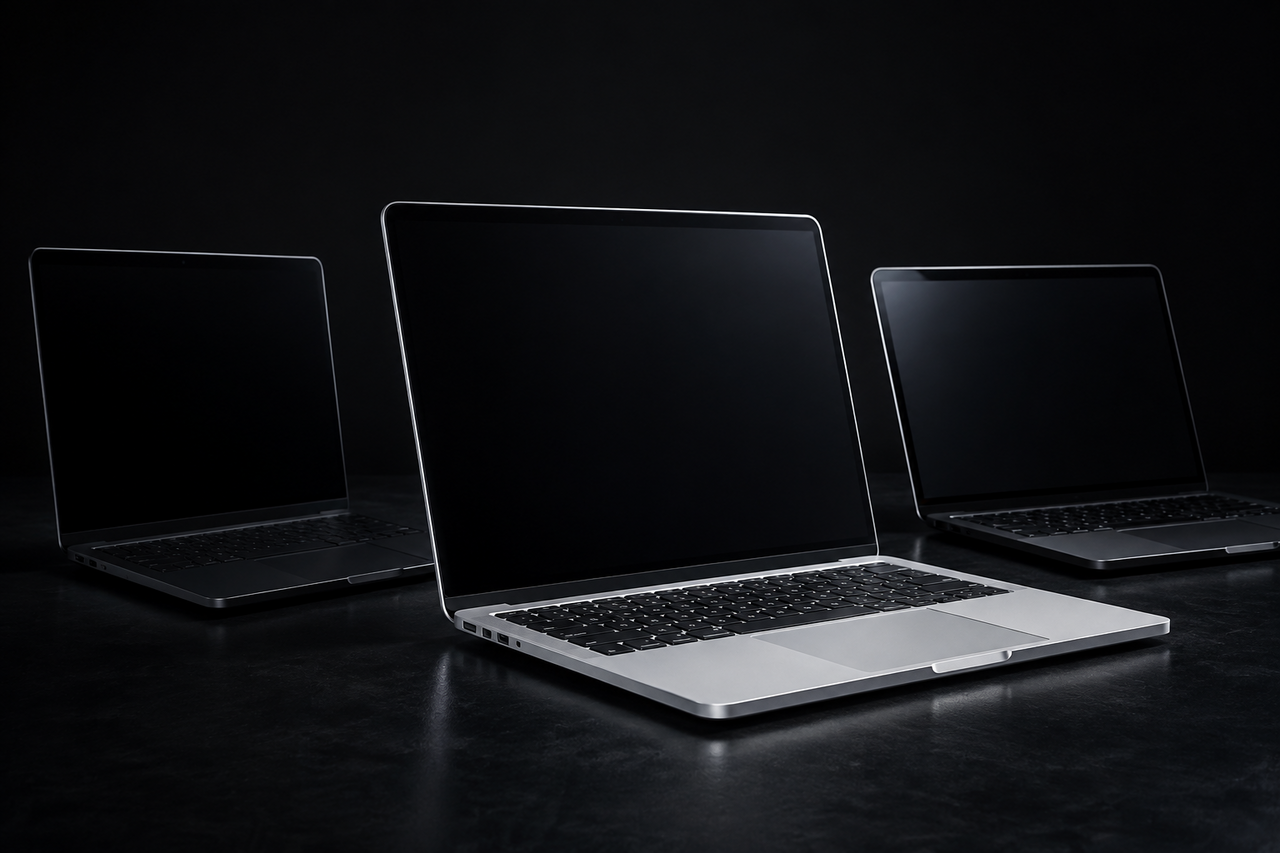
"MacBooks are just better built" is one of those claims everyone repeats and almost nobody examines. It's worth examining, because build quality isn't just bragging rights — it's a big part of why a laptop is still worth real money years later. A chassis and display that survive daily life come out the other side as a resellable machine; a flexy lid and a scuffed screen come out as e-waste. So how does a MacBook's display and body actually hold up against the two names people cross-shop most, Dell and HP? Here's a balanced look, not a puff piece.
The MacBook case: unibody aluminum and one-piece glass
Apple's structural advantage is genuine and it starts with manufacturing. A MacBook's body is machined from a single block of aluminum — the "unibody" approach — rather than assembled from multiple panels screwed and clipped together. That yields a chassis with very little flex, a lid that doesn't wobble, and tolerances that stay tight over years of opening and closing. The display is a smooth sheet of glass over the panel, which resists everyday scuffing and is easy to wipe clean. In its side-by-side of Apple versus Dell laptops, Laptop Outlet credits Apple's premium metal construction and design consistency as a defining strength of the lineup.
That build reputation carries into direct model matchups too. Comparing the MacBook Air against the Dell XPS, Every frames both as premium, well-made machines — but the MacBook Air's fanless, sealed, few-moving-parts design gives it fewer things to fail over time, which is exactly the quality that keeps an older unit desirable.
Where Dell and HP genuinely compete
Here's the part the Apple-faithful skip: the gap is narrower than it used to be, and at the top of the range it can close entirely. Dell's XPS line is legitimately premium — CNC-machined aluminum, carbon-fiber or glass-fiber decks, and a display-to-body ratio that has often led the industry. Every's comparison doesn't declare the MacBook Air a runaway winner on build; it treats the XPS as a serious peer whose main differences are platform and value, not flimsiness.
HP is the more spread-out story, and that's the honest nuance. HP's lineup ranges from budget plastic machines to the Spectre and Dragonfly premium tiers that go toe-to-toe with anyone on materials. Box's rundown of the key differences between HP and Dell laptops highlights how both brands span wide ranges, with HP leaning into design flourishes and convertible form factors and Dell known for consistent build and strong support — meaning a well-chosen HP or Dell can match a MacBook's solidity, while a bargain-bin model from either won't. The brand name alone doesn't tell you how tough a given laptop is; the tier does.
Apple's edge is consistency, not a monopoly on toughness. Every MacBook gets the same unibody-aluminum, one-piece-glass treatment, so build quality is predictable across the line. Dell's XPS and HP's premium tiers can equal it — but their cheaper models don't, so with Windows rivals the tier matters as much as the badge.
Display durability, specifically
On the screen itself, MacBook displays benefit from that continuous glass surface and a lid stiff enough that the panel isn't constantly stressed. The flip side, well documented elsewhere, is that when an Apple display does fail — a cracked panel, a coating or cable issue — the integrated assembly makes repair expensive. Many Dell and HP models use a more conventional bezel-and-panel construction that can be slightly less premium to the touch but, in some cases, cheaper to service. Toughness and repairability aren't the same thing, and Apple tends to win the first while trailing on the second.
Side by side
| Trait | MacBook | Dell (XPS tier) | HP |
|---|---|---|---|
| Chassis | Unibody aluminum, very rigid | Machined aluminum, carbon/glass fiber | Ranges: premium metal to budget plastic |
| Consistency across range | Uniform — every model | High at XPS tier | Varies widely by line |
| Display surface | One-piece glass, scuff-resistant | Premium panels, strong bezels | Strong on premium tiers |
| Repair when damaged | Costly (integrated assembly) | Often more serviceable | Varies by model |
Why this feeds resale value
Build quality and resale value are the same story told at two different times. A machine that resists flex, dings, and screen wear simply arrives at year three or four in sellable shape — and because MacBooks deliver that toughness uniformly across the line, a used MacBook is a more predictable bet for a buyer than a used Windows laptop that could be a premium XPS or a plastic budget unit wearing the same brand. Predictability is worth money in the resale market, and it's a real part of why well-kept MacBooks hold value the way they do. None of that disparages a good Dell or HP — a high-tier one ages beautifully too. It just explains why the MacBook's floor is higher.
If your MacBook's build has held up — or even if the screen finally lost a fight with a backpack — that durability is money you can collect now. Encore gives you an instant online offer in about 30 seconds, a free prepaid, insured shipping label, and payment once the Mac arrives, with the offer you accept being the offer you're paid. It buys broken and cosmetically damaged units too, so a cracked display doesn't take a well-built machine out of the running. It won't always beat a flawless private sale on the last dollar, but it turns years of solid build quality into a clean, safe payout — no stranger to meet, no chargeback risk. You can see what your MacBook is worth as-is in about the time this paragraph took to read.
Get an instant offer on your Mac
A real number in about 30 seconds — working or not. Free prepaid shipping, no seller fees, paid the day it arrives.*
Get my offerSources
More from Encore
 Value & Depreciation
Why MacBooks Hold Their Value Better Than Windows Laptops
Long software support, durable build, ecosystem pull, and steady demand keep used MacBooks worth far more than Windows laptops.
Sep 27, 2026 · 6 min read
 Value & Depreciation
Mac Studio vs Mac Pro: Which Holds Value Better?
Same silicon, very different depreciation: why the Mac Studio resells easily and the Mac Pro gives back more of its value.
Sep 27, 2026 · 6 min read
 Value & Depreciation
The iMac Pro: An Orphaned Powerhouse's Second Life
Discontinued, now Intel-sunset, still capable: who the iMac Pro is for in 2026 and how to value one.
Sep 27, 2026 · 6 min read