Why Are Out-of-Warranty Apple Repairs So Expensive?
Apple replaces whole assemblies, not components, and pairs parts in software — here's why an out-of-warranty Mac repair costs what it does.
Encore Editorial · Sep 4, 2026 · 7 min read
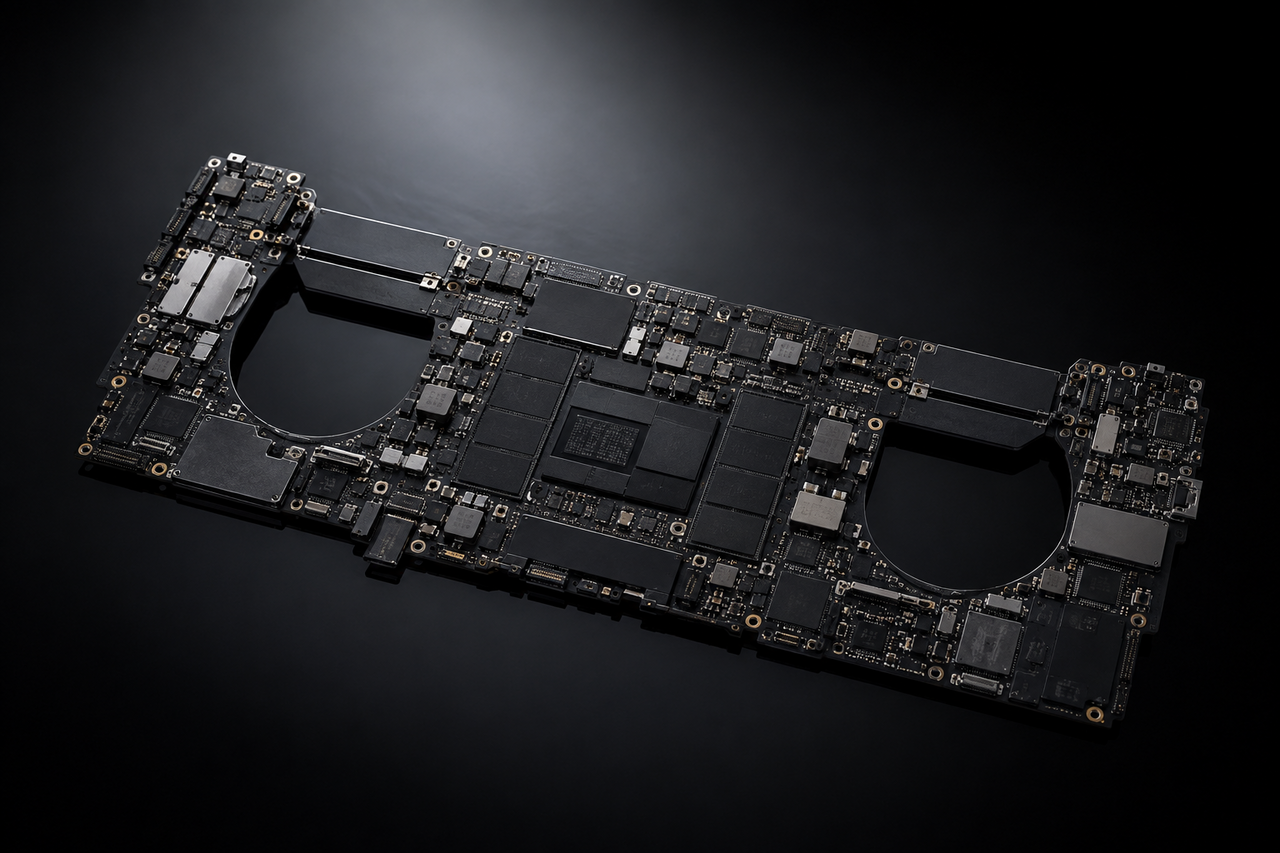
Get a repair quote from Apple after your warranty has lapsed and the number can be startling — often a meaningful fraction of what the machine cost new. There is a reason out-of-warranty Apple repairs are so expensive, and it is not simply that Apple likes charging a premium. It comes down to how modern Macs are built, how Apple defines a "part," and a software layer that ties components to the specific machine they shipped in. Understanding the mechanics helps you decide whether a repair is worth it — or whether you are pouring money into a machine that has already told you what it's worth.
The sticker shock is real
Start with the numbers that are easy to verify. A battery is a consumable — it wears out on every laptop ever made — yet Apple's out-of-warranty battery service costs meaningfully more for most MacBook Pro models than for a MacBook Air, according to iFixit's repair pricing — and even the Air's flat fee is far from trivial for a consumable part. Screens and logic boards climb far higher. And those are the routine jobs. The moment a repair touches the display assembly or the main board, quotes commonly land in the several-hundred to four-figure range depending on the model.
What makes the battery example telling is that the part itself is cheap. iFixit sells its own MacBook battery kits for a small fraction of Apple's flat fee. The gap between that and Apple's price isn't parts — it's everything Apple wraps around the part.
The short version: Apple rarely replaces the small thing that broke. It replaces the large, expensive assembly the small thing is attached to — and prices the labor to match.
Apple replaces assemblies, not components
Here is the design decision that drives most of the cost. On current Macs, individual components are fused, glued, or soldered into larger units, so a single failure forces replacement of the whole assembly.
The battery is the clearest case. On the M4 and M5 MacBook Pro, Apple's official fix for a dead battery is to swap the entire top case — keyboard, speakers, trackpad and all. iFixit found Apple's Self Service Repair store sells that top-case-with-battery assembly at a steep price on the M4 model, and notes it is "the only offering they make for changing out a dead battery" currently. The keyboard is more or less permanently affixed to the aluminum top case and the speakers are glued in, so Apple treats them as one indivisible unit. You are not buying a battery. You are buying most of the bottom half of the laptop.
The same logic runs through the rest of the machine. The display is a bonded assembly rather than a replaceable panel. Memory and storage are soldered to the board on Apple Silicon, so a failed storage chip can mean a new logic board. Every one of these choices trades repairability for thinness and durability — a defensible engineering call — but it means the smallest failure carries the price of the largest part it lives on.
Parts pairing adds a software lock on top
Even if you source a genuine Apple part, the machine may not fully accept it. Apple links component serial numbers to the specific device they shipped in — a practice known as parts pairing or serialization. When the numbers don't match, the device throws warnings or disables features.
iFixit has documented the mechanism in detail: tiny microcontrollers store serial numbers, and the device runs what iFixit calls a "roll-call" checking that its components match. Swap in an identical genuine Apple battery from another unit and you get a persistent "Unable to verify this iPhone has a genuine Apple battery" notice plus disabled battery-health reporting. On some iPhones, an unauthorized display swap has disabled Face ID entirely — even genuine glass, installed correctly, degraded because the pairing wasn't blessed by Apple's software.
The consequences reach the wider repair economy. As 9to5Mac reported, refurbishers say serialization blocks the oldest cost-saving trick in repair: harvesting good components from broken units. A Back Market executive told the outlet it is "a very big threat on refurbishment, and the cost of repair in refurbishment, that we need to address." When shops can't reuse salvaged parts, every repair has to start with a full-price part bought new from Apple.
Why independent shops can't undercut the quote
This is the piece most people miss. Independent repair shops are supposed to be the cheaper alternative — and for many jobs they are. But parts pairing narrows the gap. Shops that can't access Apple's pairing software are left choosing between expensive microsoldering, accepting that the customer will live with error messages, or joining Apple's restrictive repair program. iFixit noted that Apple charges nearly as much for a screen part alone as it does for the screen-plus-installation in-store — pricing that leaves almost no room for anyone else to compete on the part itself.
The math that actually matters
None of this makes Apple's repairs a scam — bonded assemblies really are more durable, and serialization has genuine security uses. But it does mean out-of-warranty repair pricing tracks the cost of a big assembly plus skilled labor plus a software gate, not the cost of the thing that failed. For an owner, the practical question is simpler: does the repair cost more than the machine is worth afterward?
Run the numbers honestly:
- Compare against residual value, not the original price. A four-year-old MacBook is worth what a four-year-old MacBook sells for today — not what you paid. A top-case-and-battery assembly that costs nearly as much as the whole aging laptop is worth is rarely a good trade.
- Count the second failure. Older machines that need one expensive repair often need another within a year. You may be buying time, not a fix.
- Factor in downtime and risk. A repaired-but-aging Mac still ages. The clock doesn't reset.
When the quote approaches or exceeds what the Mac is worth working, repairing it is often the expensive choice. A broken or damaged Mac still has real salvage value — its case, board, display, and chip are worth something to someone who refurbishes or parts out machines for a living. Encore is one of those buyers: it purchases broken and damaged Macs directly, so instead of paying Apple to fix a machine you may not keep, you can get an as-is offer and put that money toward whatever comes next. If it's a Pro specifically, you can see what it's worth as-is before you commit to the repair.
Before you approve a repair, get the machine's as-is value first. If fixing it costs more than the Mac is worth once fixed, the repair is the money pit — and the honest move is to sell it as-is and walk away clean.
The bottom line
Out-of-warranty Apple repairs are expensive because Apple replaces whole assemblies rather than components, glues and solders those assemblies together for thinness and durability, and pairs parts in software so genuine components can't be freely swapped or salvaged. Each choice has a rationale, and together they push the price of even a modest failure toward the cost of a significant chunk of the machine. Knowing that, the smart play isn't to fear the quote — it's to weigh it against what your Mac is actually worth, and let the honest number decide whether you fix it or move on.
Get an instant offer on your Mac
A real number in about 30 seconds — working or not. Free prepaid shipping, no seller fees, paid the day it arrives.*
Get my offerSources
More from Encore
 Repairs & Reliability
The Spinning-Disk iMac: Upgrade It or Sell It?
An SSD can transform a slow hard-drive iMac, but the glued display makes it tricky. Here's when to upgrade and when to just sell.
Sep 27, 2026 · 6 min read
 Repairs & Reliability
Liquid Damage Doesn't Always Total a Mac
A spill's real enemy is corrosion, not water. Why many liquid-damaged Macs are repairable — and still hold value if they aren't.
Sep 25, 2026 · 6 min read
 Repairs & Reliability
Flexgate and Staingate: Old Display Defects That Still Hit Resale
What Flexgate and Staingate are, which MacBook Pros they hit, and how each one moves used value years after Apple's repair programs ended.
Sep 25, 2026 · 6 min read