Is It Worth Replacing the Battery Before Selling Your Mac?
A worn Mac battery lowers an offer less than a replacement costs. Here's when to service it and when to disclose and sell as-is.
Encore Editorial · Sep 24, 2026 · 6 min read
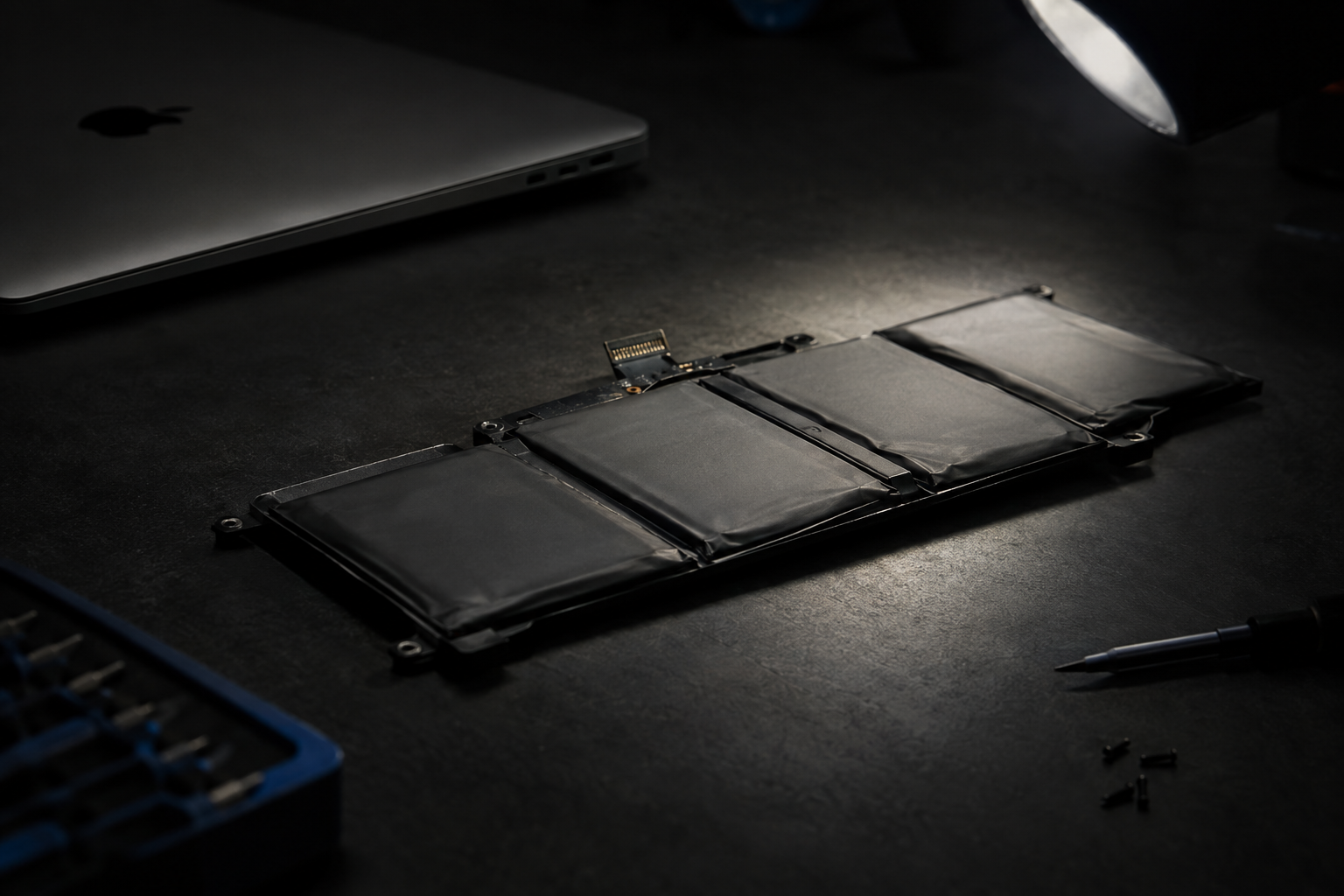
A tired battery is the most common thing owners worry about when it comes time to move on from a laptop, so the question comes up constantly: is it worth replacing the battery before selling your Mac? The honest answer is that it usually is not — not because battery health does not matter, but because the math rarely works in your favor once you account for what a service actually costs and what a buyer is really looking at.
A notebook battery is a consumable part. It wears out with use, and every Mac laptop ever made will eventually show its age here. Understanding how that wear is measured, and how it feeds into a resale offer, is the key to deciding whether to spend money fixing it first.
What a buyer actually looks at before replacing the battery
Before you assume the battery is a dealbreaker, it helps to know exactly what a knowledgeable buyer checks. There are only two numbers that matter, and both live in the same place. As AppleInsider's used-Mac buying guide lays out, you hold the Option key, open the Apple menu, choose System Information, and look under Power for two values: Cycle Count and Condition.
Apple explains that a charge "cycle" is not the same as a charge. Using half the battery one day and half the next counts as a single cycle, so a cycle can take several days to complete, per Apple's own documentation. Modern MacBook Air and MacBook Pro models are rated for roughly 1,000 cycles, and Apple designs the battery to retain up to 80% of its original capacity at that maximum. Once a battery reaches that point, a replacement is recommended to maintain performance.
The Condition field is the other tell. When it reads Service Recommended, Apple says that means "the battery's ability to hold charge is less than when it was new, or it isn't functioning normally," as its support note puts it. Crucially, Apple adds that you can safely keep using the Mac — a Service Recommended battery is not a broken machine, just a worn one.
The short version: A worn battery lowers an offer far less than a fresh replacement costs. In most cases the smart move is to disclose the cycle count and condition honestly and sell as-is, not to pay for service first.
Why replacing the battery before selling rarely pays back
Here is the problem with pre-sale battery service: it is not cheap, and it is not something you can quietly do yourself on a modern Mac. Apple is explicit that "Mac laptops with built-in batteries should have their batteries replaced only by an Apple Authorized Service Provider or Apple Store, or by an Independent Repair Provider that uses genuine Apple parts." Do-it-yourself work with off-brand parts risks damage that voids your warranty, and it is genuinely difficult — iFixit's Mac laptop teardowns show batteries that are glued into the chassis on most recent models, which is why the repair carries real labor cost.
So the choice is between an official service you pay full price for and a resale value that improves only modestly. A worn battery reduces what a machine is worth, but it does not erase it — a Mac with a high cycle count still runs, still holds a charge, and is still perfectly usable plugged in. The gap between "worn battery" and "new battery" in resale terms is almost always smaller than the price of the replacement itself. You would be spending real money to recover a fraction of it.
There is also a timing trap. If you pay to replace the battery and then sell the Mac a week later, you have effectively paid to improve a machine you no longer own. The buyer captures the benefit; you captured the bill.
The cases where a battery replacement is worth it
The calculus flips in a few specific situations. Replacing the battery first can make sense when:
- You are keeping the Mac for a while longer. If you will use the machine for another year or two before selling, you get the benefit yourself, and the sale is a distant secondary consideration.
- The battery has swollen or is a safety issue. A swollen battery can push against the trackpad or case and is a genuine hazard. That should be dealt with regardless of resale plans — though a buyer who repairs and refurbishes will also handle it.
- You have warranty coverage. Apple notes that under an AppleCare plan it will replace a battery at no extra charge when capacity falls below 80%. If service is free to you, do it.
Outside of those cases, disclosure beats repair. A buyer who sees an accurate cycle count and Condition reading knows exactly what they are getting, and an honest listing closes faster than a vague one.
Disclose the numbers and let the offer do the work
The most useful thing you can do before selling is not spending money — it is gathering information. Note the cycle count and Condition from System Information, mention any Service Recommended flag, and be upfront about how the machine behaves unplugged. That transparency protects you from a dispute later and tends to build buyer confidence.
It also means you do not have to guess at the trade-off yourself. A dedicated buyer prices the battery's wear into the offer directly, and — importantly — buys machines with tired or even non-functional batteries, because a refurbisher can service them at parts cost rather than retail. The fastest way to see how much a worn battery actually changes the number is to get a real offer in about thirty seconds and compare it against what a replacement would have cost you. In most cases you will find the difference is smaller than the repair bill.
Whatever number you see is the number: a reputable buyer that quotes on the battery's stated condition should not revise the offer downward when the machine arrives and the battery is exactly as described.
The bottom line
Replacing the battery before selling your Mac is one of those upgrades that feels responsible but usually loses money. A worn battery is a normal, expected form of wear that a buyer already accounts for, and modern built-in batteries are expensive enough to service that you rarely recover the cost at resale. Unless you are keeping the machine longer, dealing with a swelling safety issue, or covered by warranty, the winning move is simple: pull up the cycle count and Condition, describe them honestly, and let the offer reflect reality rather than paying to inflate it.
Get an instant offer on your Mac
A real number in about 30 seconds — working or not. Free prepaid shipping, no seller fees, paid the day it arrives.*
Get my offerSources
More from Encore
 Repairs & Reliability
The Spinning-Disk iMac: Upgrade It or Sell It?
An SSD can transform a slow hard-drive iMac, but the glued display makes it tricky. Here's when to upgrade and when to just sell.
Sep 27, 2026 · 6 min read
 Repairs & Reliability
Liquid Damage Doesn't Always Total a Mac
A spill's real enemy is corrosion, not water. Why many liquid-damaged Macs are repairable — and still hold value if they aren't.
Sep 25, 2026 · 6 min read
 Repairs & Reliability
Flexgate and Staingate: Old Display Defects That Still Hit Resale
What Flexgate and Staingate are, which MacBook Pros they hit, and how each one moves used value years after Apple's repair programs ended.
Sep 25, 2026 · 6 min read