Cracked Trackpad or Keyboard: Repair First or Sell As-Is?
On modern MacBooks the trackpad and keyboard are riveted into the top case with the battery. That fact decides whether to repair or sell as-is.
Encore Editorial · Sep 24, 2026 · 6 min read
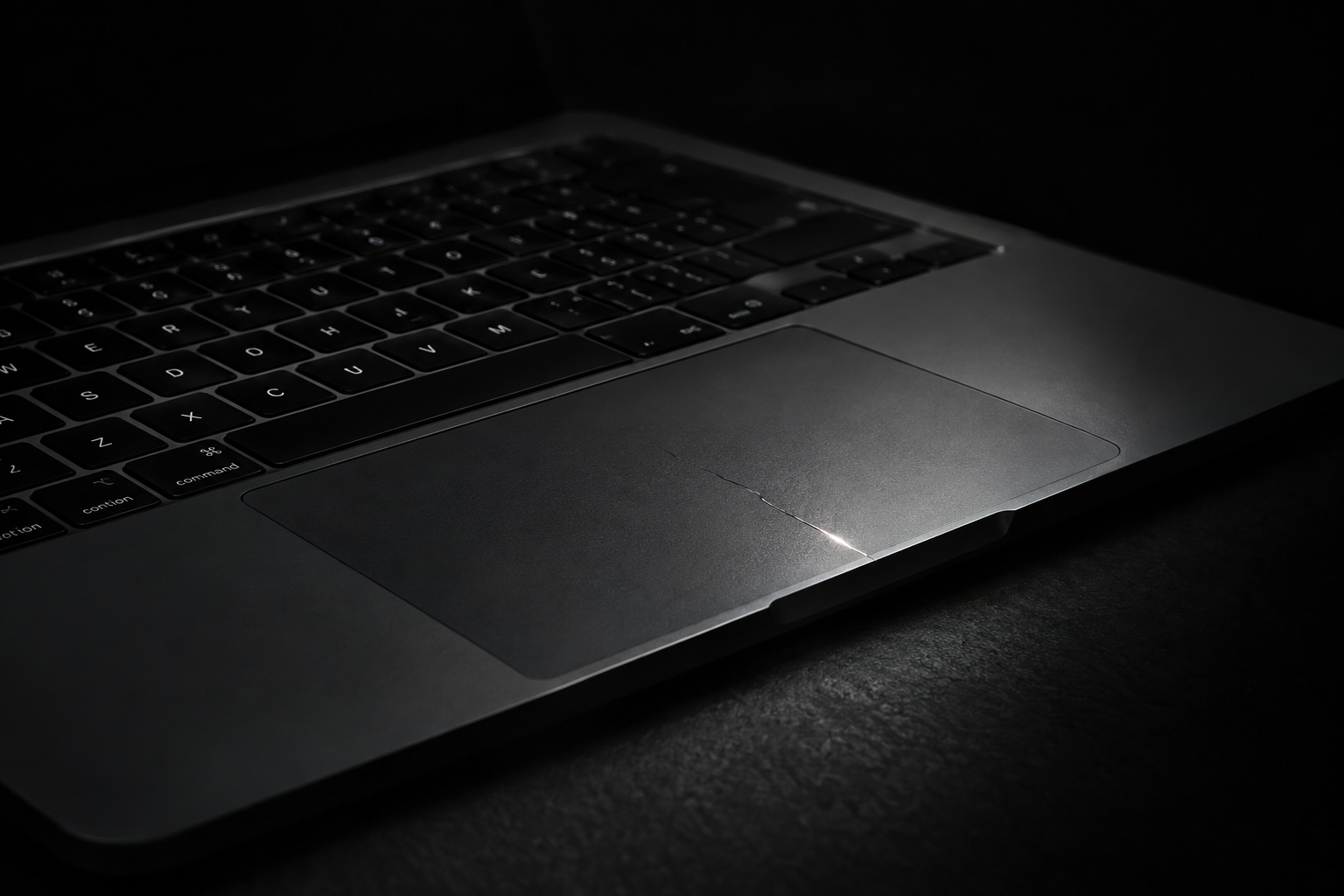
A cracked trackpad or a keyboard with dead, sticky, or shattered keys is one of the more frustrating ways a MacBook falls short of "perfect" while still being perfectly usable. It is also one of the trickiest repair-or-sell decisions, because on a modern Mac these two components are not the cheap, isolated parts they look like. Before you book a repair on a cracked trackpad or keyboard — or write the machine off — it helps to understand how these parts are actually built, because that single fact drives the whole calculation.
Why a cracked trackpad or keyboard is rarely a small repair
On almost every recent MacBook, the keyboard and trackpad are not modules you unclip and swap. They are built into the top case — the aluminum upper half of the chassis that also houses the battery. iFixit's teardowns have documented this for years: the keyboard is held in with dozens of rivets, and, as their butterfly-keyboard analysis put it, "in order to get to the keyboard at all you need to gut the MacBook, peel off a large backing sticker, remove a whole brace of screws and bust through more than a dozen rivets." The consequence is exactly what you would expect: the same piece notes that this is "why Apple is replacing entire top case assemblies — including batteries — when they only really need to replace the keyboard."
The trackpad sits in the same assembly and is subject to the same reality. In practice, a cracked trackpad or a failed keyboard often means replacing the whole top case, which brings the battery and keyboard along whether you needed them or not. A repair community thread on a recent MacBook Air captures the difficulty for anyone attempting it themselves: "the full uppercase needs to be bought" as a single unit, and even then, sourcing the correct part for newer models can be hard.
The short version: On modern MacBooks the trackpad and keyboard are riveted into the top case with the battery, so a real fix usually means replacing the whole assembly. That makes repair worthwhile mainly on higher-value machines — and for many, selling as-is (Encore buys damaged units) is the cleaner call.
The workaround before you decide anything
If the keyboard or trackpad is only partly failing, you have a stopgap that costs nothing and can change the math: external peripherals. A USB or Bluetooth keyboard and mouse fully sidestep a broken built-in keyboard or a dead trackpad, and for a desktop-style setup that is a permanent, painless fix. That does not raise the machine's resale value — a buyer still sees a damaged laptop — but it does buy you time to make the repair-or-sell decision calmly instead of under pressure. It also tells you something useful: if you are happy running the Mac on an external keyboard, the internal damage may not be worth paying to fix at all.
When a repair pays back
Because the fix is a top-case job, repair economics hinge almost entirely on how valuable the machine is to begin with. A full top-case replacement can eat up a large share of what a modest or older MacBook is even worth, and pouring that into a machine near the end of its useful life rarely returns the money at resale. The pattern that tends to make repair sensible:
- The Mac is recent and high-spec. On a current-generation, well-configured MacBook Pro or Air, restoring it to fully working, cosmetically clean condition can lift the resale price by more than the repair costs — and it widens the pool of buyers who want a flawless machine.
- You're keeping it, not selling it. If the machine still suits you, a repair that comes with a fresh battery (since the top case includes one) can be a genuine second-life upgrade, not just a patch.
- The damage is cosmetic-plus-functional. A cracked trackpad that also misbehaves, or a keyboard with multiple dead keys, is worth fixing on a valuable machine because it fails a buyer's basic inspection — and buyers do inspect. AppleInsider's used-Mac guide tells shoppers to test every key and the trackpad for responsiveness, flagging that certain 2016–2019 butterfly keyboards are "especially prone to key failures."
When selling as-is is the smarter move
The opposite case is just as common. Repair stops making sense when the top-case job approaches or exceeds what the working machine is worth, when the model is older or Intel-based and already sliding down the value curve, or when you simply do not want to front repair money and wait on a part that may be hard to find. In those situations, selling the Mac in its current condition is often the cleaner, faster outcome — you skip the labor, the parts-sourcing gamble, and the risk of a botched teardown.
This is where it helps that a damaged Mac is not a worthless one. A cracked trackpad or a dead keyboard does not erase the value of the display, the logic board, the chip, the memory, or the rest of the chassis, and buyers who repair and refurbish machines price accordingly. Because the top case is a known, well-documented replacement, a specialist can factor the fix into an offer rather than rejecting the machine outright. If you would rather not deal with the repair yourself, you can get an instant offer in about thirty seconds on the Mac exactly as it is — damage disclosed, no repair required first — and the offer already accounts for the condition.
How to decide, quickly
Run the machine through three questions:
- Is it recent and high-value? If yes, a repair is more likely to pay back — especially if you plan to keep it or want top resale.
- Can an external keyboard or mouse make it fully usable for you? If yes and you are keeping it, you may not need to repair anything.
- Is it older, Intel, or already worth little? If yes, a top-case repair rarely returns its cost — selling it as-is to someone who buys damaged units is usually the better outcome.
The bottom line
A cracked trackpad or keyboard is not the small fix it appears to be, because Apple built both into a riveted top case that carries the battery with it. On a recent, valuable MacBook, that repair can still pay for itself at resale or give a machine you're keeping a fresh lease on life. On an older or low-value one, the fix often costs more than it returns — and since damaged Macs retain real value in parts and refurbishment, selling as-is is frequently the faster, smarter call. Match the repair to the machine's worth, and let the built-for-replacement design, not wishful thinking, make the decision.
Get an instant offer on your Mac
A real number in about 30 seconds — working or not. Free prepaid shipping, no seller fees, paid the day it arrives.*
Get my offerSources
More from Encore
 Repairs & Reliability
The Spinning-Disk iMac: Upgrade It or Sell It?
An SSD can transform a slow hard-drive iMac, but the glued display makes it tricky. Here's when to upgrade and when to just sell.
Sep 27, 2026 · 6 min read
 Repairs & Reliability
Liquid Damage Doesn't Always Total a Mac
A spill's real enemy is corrosion, not water. Why many liquid-damaged Macs are repairable — and still hold value if they aren't.
Sep 25, 2026 · 6 min read
 Repairs & Reliability
Flexgate and Staingate: Old Display Defects That Still Hit Resale
What Flexgate and Staingate are, which MacBook Pros they hit, and how each one moves used value years after Apple's repair programs ended.
Sep 25, 2026 · 6 min read