The Butterfly-Keyboard Era: Selling a 2016–2019 MacBook
Sticky keys, a class-action settlement, and a repair program that just closed — here's what the butterfly keyboard does to a used MacBook's value.
Encore Editorial · Sep 6, 2026 · 6 min read
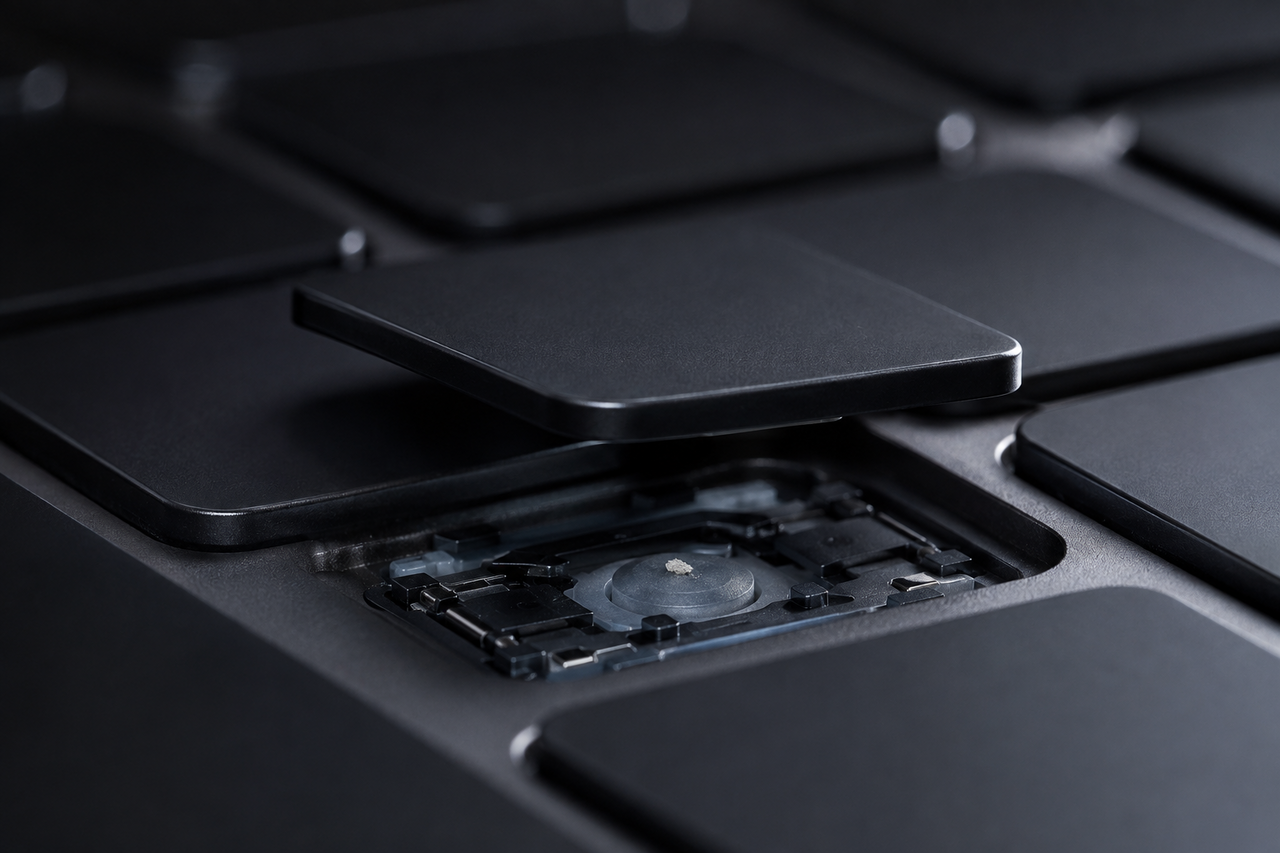
For a stretch of about four years, buying a MacBook meant living with one of Apple's most notorious design decisions: the butterfly keyboard. Shipped from the 2015 12-inch MacBook through the 2019 lineup, it was thin, quiet, and — for a meaningful share of owners — maddeningly unreliable. If you still have a 2016–2019 MacBook Pro, MacBook Air, or 12-inch MacBook in a drawer, the butterfly keyboard is the single biggest factor shaping what that machine is worth today. Here is the full story, and what it means when you go to sell.
What actually went wrong
The butterfly mechanism traded the scissor switch's travel for a flatter, wider key that let Apple shave millimeters off the chassis. The problem was tolerance. The mechanism sat so close to the top case that, as MacRumors documented, crumbs, dust, and other fine particulates could lodge underneath and knock a key out of action. Three failure modes became the signature of the era: letters repeating unexpectedly, letters not registering at all, and keys that felt sticky or dead.
This was not a rounding-error defect. In the class-action litigation that followed, AppleInsider reported that service data showed the butterfly keyboard failing roughly twice as often as its predecessor during the first year on the market. Apple iterated — a second generation in 2016, then a 2019 third generation with a new membrane meant to keep debris out — but the reputation was already set, and even the revised versions kept generating complaints.
The short version: every MacBook sold from 2015 through 2019 used the butterfly keyboard, a mechanism so sensitive that a single speck of dust could disable a key. That fragility is now baked into how buyers price these machines.
Why one dead key is a whole-laptop problem
Here is the detail that turns an annoyance into an expensive repair. On these MacBooks, the keyboard is not a serviceable part. It is riveted into the top case alongside the battery, trackpad, and speakers. As iFixit put it, "for Apple's service team, the entire upper half of the laptop is a single component." Individual keys resist removal — iFixit noted the spacebar "breaks every single time anyone, including a professional, tries to remove it" — so the standard fix for one flaky key is to replace the whole assembly.
That design choice is why iFixit was so scathing about the era's repairability, and it is why an out-of-warranty top-case replacement historically cost enough to eat a meaningful share of an aging MacBook's resale value. A tiny mechanical failure cascades into a major-component swap, and there is no cheap, clean way for a home user to route around it.
The service program that no longer helps you
Apple did eventually respond. It launched a free Keyboard Service Program in June 2018 and, in May 2019, expanded it to cover every butterfly-equipped MacBook, MacBook Air, and MacBook Pro. Coverage ran four years from the original date of purchase.
The catch: that clock has now run out for everyone. Apple formally ended the program in November 2024, roughly six and a half years after it began. Even the last eligible 2019 machines aged past their four-year window in 2023. In practical terms, a butterfly-keyboard repair is now fully out of pocket. If yours starts double-typing today, there is no free fix waiting at the Genius Bar.
There was also a separate financial remedy. In July 2022 Apple agreed to an eight-figure settlement over the keyboards, and — while denying any wrongdoing — paid affected owners in a set of US states on a sliding scale that climbed with the severity of their repairs: the smallest payouts for keycap replacements, more for a single top-case replacement, and the largest sums for owners who had been through multiple repairs. Those payments went out in 2024, and that door has closed too.
What the butterfly keyboard does to resale value
Buyers of used Macs are well aware of this history, and it shows up in pricing three ways.
- A working butterfly Mac still sells at a discount to its scissor-switch successors. The 2020 and later MacBooks that returned to the Magic Keyboard command a premium precisely because they sidestepped the whole problem. A comparable 2017 or 2018 model carries a permanent asterisk.
- An actively failing keyboard drops the value further, but rarely to zero. Because the repair means a top-case replacement, buyers price in that cost — but the rest of the machine (display, logic board, storage) often has plenty of life left, so a glitchy unit is worth far more than owners assume.
- Condition disclosure matters more than usual. "One sticky key" and "half the row doesn't register" are very different machines. Being specific about which keys fail, and how consistently, is what separates a fair offer from a lowball.
The instinct many owners have — that a keyboard problem makes the laptop unsellable — is simply wrong. It makes it a repair-priced machine, not a worthless one.
Should you fix it before selling?
Usually, no. With the free program gone, a top-case replacement on a six-to-nine-year-old laptop frequently costs more than the repair adds back to the sale price. You would be spending real money to fix a component on a machine that is already discounted for its generation. In most cases the math favors selling the Mac as-is and letting the buyer absorb the repair.
This is exactly the kind of unit that trips people up. It still boots, the screen is gorgeous, the aluminum is clean — but a keyboard fault makes it feel unsellable, so it sits in a drawer depreciating. It doesn't have to. Encore buys butterfly-era MacBooks with keyboard problems, broken or not, with the price quoted up front — the offer you accept is the offer you're paid, so a failing keyboard won't turn into a surprise deduction after the box arrives.
Before you list or sell
Whatever route you take, a few minutes of prep protects your value: sign out of your Apple Account and turn off Find My so the machine isn't locked, back up anything you need, and note the exact model year and which keys misbehave. An honest, specific description of a butterfly keyboard is worth more than a hopeful "works fine" that falls apart on inspection.
The bottom line
The butterfly keyboard was a genuine engineering misstep, and Apple spent years — and an eight-figure settlement — cleaning up after it. For owners of 2016–2019 MacBooks, that legacy sets a ceiling on resale value and, if the keyboard is failing, chips away a bit more. But it does not erase the value. These are still capable machines with plenty of usable hardware, and with the repair program now closed, the cleanest exit for most owners is to sell as-is rather than pour money into a top-case swap. If a butterfly MacBook has been gathering dust, it is worth finding out what it fetches before it depreciates further.
Get an instant offer on your Mac
A real number in about 30 seconds — working or not. Free prepaid shipping, no seller fees, paid the day it arrives.*
Get my offerSources
- MacRumors — MacBook Pro / Air Butterfly Keyboard Issues (Repeating, Stuck, Unresponsive)
- MacRumors — Apple Ends Butterfly Keyboard Repair Program for MacBooks
- AppleInsider — Apple agrees to $50M settlement in MacBook butterfly keyboard lawsuit
- iFixit — Apple Engineers Its Own Downfall With the MacBook Pro Keyboard
More from Encore
 Repairs & Reliability
The Spinning-Disk iMac: Upgrade It or Sell It?
An SSD can transform a slow hard-drive iMac, but the glued display makes it tricky. Here's when to upgrade and when to just sell.
Sep 27, 2026 · 6 min read
 Repairs & Reliability
Liquid Damage Doesn't Always Total a Mac
A spill's real enemy is corrosion, not water. Why many liquid-damaged Macs are repairable — and still hold value if they aren't.
Sep 25, 2026 · 6 min read
 Repairs & Reliability
Flexgate and Staingate: Old Display Defects That Still Hit Resale
What Flexgate and Staingate are, which MacBook Pros they hit, and how each one moves used value years after Apple's repair programs ended.
Sep 25, 2026 · 6 min read