The Real Risks of Selling Your Mac Locally for Cash
Fake payments, counterfeit bills, and unsafe meetups are the hidden costs of a local cash sale. Here's how to sell safely, or skip the risk entirely.
Encore Editorial · Sep 26, 2026 · 6 min read
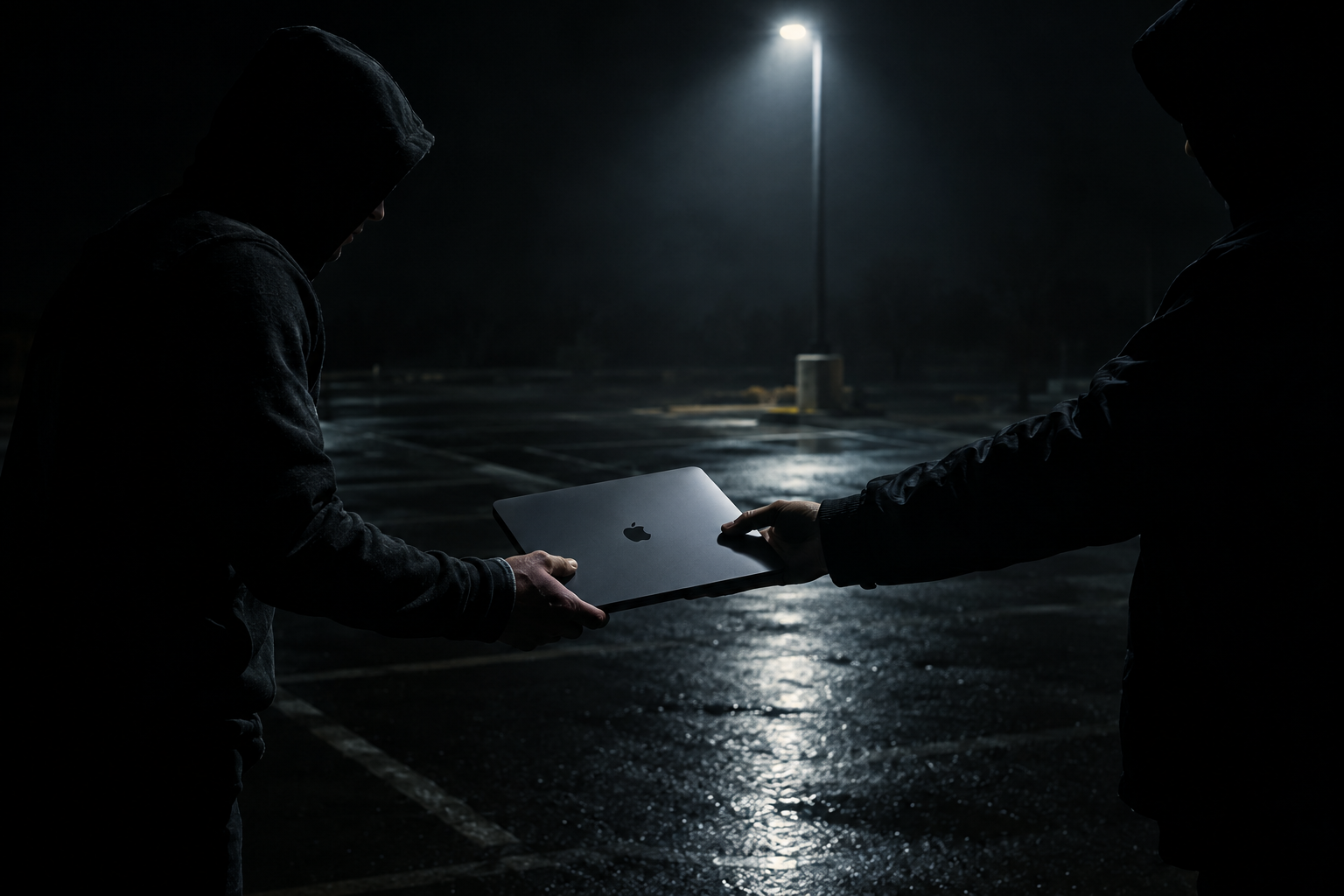
Selling your Mac locally for cash sounds like the clean option: no shipping, no waiting, money in hand the same day. For plenty of transactions it works out fine. But the real risks of selling your Mac locally are the ones people don't price in until something goes wrong — a fake payment, a "buyer" who never intended to pay, or a meetup that turns into a robbery. A used laptop is a compact, high-value item that a stranger has agreed to meet you for, and that combination is exactly what fraud and theft prey on.
None of this means local sales are reckless. It means the convenience comes with a set of specific, well-documented hazards, and knowing them is the difference between a smooth handoff and a bad afternoon.
The short version: Local cash sales expose you to fake or reversed payments, counterfeit bills, and personal-safety risk at the meetup. Public locations, daytime meetings, a companion, and verified payment reduce the danger — but they don't eliminate the core problem that you're meeting a stranger over a valuable object.
The payment risks of selling your Mac locally
The most common way a local sale goes wrong isn't dramatic — it's a payment that looks real and isn't. Scammers lean on payment apps precisely because the money is hard to claw back. As the FTC explains, once funds move through an app "it's hard for you to get your money back," because the payment lands in the recipient's balance first, giving a fraudster time to move it before you notice anything is wrong. A buyer can flash a screenshot of a "sent" payment, or a pending transfer that later fails, and walk off with your Mac before the money ever clears.
The FTC's guidance is worth applying in reverse when you're the seller: "before you submit any payment, double-check the recipient's information" — and, as a seller, don't hand over the goods until money has actually landed in your account, not merely shown as "sent." The agency also warns broadly against certain payment methods, advising in its how-to-avoid-a-scam guide to "never pay someone who insists that you can only pay with cryptocurrency, a wire transfer service like Western Union or MoneyGram, a payment app, or a gift card." A buyer who steers you toward an unusual or irreversible method is waving a flag.
Cash isn't a magic fix either. Counterfeit bills are a real problem in high-value handoffs, and "I'll pay you back the difference" overpayment tricks — where a buyer pays too much and asks for change back on a payment that later reverses — are a classic. The FTC's blunt rule: "never deposit a check and send money back to someone."
The safety risk people underestimate
The second category is physical. You've agreed, in public, to meet a stranger who knows you're carrying either an expensive laptop or the cash from selling one. Police departments treat this seriously enough to publish guidance and open their parking lots for it. The Houston Police Department recommends meeting "in a public place such as a restaurant or shopping center or anywhere where there is a high volume of pedestrian or vehicle traffic," avoiding meetings at night, and — regardless of time or place — always taking "a family member or friend to observe and witness the transaction."
Two caveats matter. First, many police stations now offer their lots as designated safe-exchange zones, but officers generally won't take part: Houston's guidance notes they "will not engage in the transaction by running serial numbers to determine whether a particular item has been reported stolen or missing, nor will officers be available to witness the sale." The location deters trouble; it isn't a bodyguard. Second, the department warns that criminals use "financial or personal information such as credit cards or driver's license information to engage in identity theft," so be careful about what you share to "prove" a transaction.
How to lower the risk if you sell locally
If you decide a local sale is worth it, stack the odds in your favor:
- Meet in a busy public place in daylight — a police-designated exchange zone or a crowded, well-lit spot with cameras and foot traffic.
- Bring someone. A second person is both a witness and a deterrent.
- Verify payment before the Mac leaves your hands. Cash should be checked; app or bank transfers should be confirmed as settled in your account, not just shown as "sent."
- Refuse unusual payment methods. Gift cards, wire services, crypto, or overpayment-with-change requests are red flags.
- Guard your personal information and don't share ID details you don't have to.
- Erase and unlock the Mac first so you're not exposing your data during a demo, and so the sale is legitimate.
The alternative that removes both risks
The reason a shipped, inspected sale exists is that it structurally removes the two hazards above. There's no meetup, so the safety risk disappears. And when a buyer commits to a price up front, sends a tracked prepaid label, and pays after the machine is received and verified, the fake-payment dynamic is gone — the money moves through a business on a documented timeline rather than in a parking lot on a stranger's word. A dedicated buyer that gives you an instant offer in about thirty seconds, then handles shipping and pays on arrival, trades the illusion of same-day cash for a process where nobody has to trust a screenshot.
That isn't to say every local sale ends badly — most don't. It's that the risks are asymmetric. A smooth local sale saves you a day or two; a bad one can cost you the Mac, the money, or worse. When the downside is that lopsided, it's worth being honest about what you're actually trading for that convenience.
The bottom line
The real risks of selling your Mac locally come down to payment fraud and personal safety, and both are well-documented enough that police departments and the FTC publish advice on them. If you sell locally, meet in a busy public place in daylight, bring someone, verify payment before you hand anything over, and never accept an unusual payment method. If avoiding those risks entirely sounds better than same-day cash, a tracked, pay-on-arrival sale removes the meetup and the mystery payment in one move.
Get an instant offer on your Mac
A real number in about 30 seconds — working or not. Free prepaid shipping, no seller fees, paid the day it arrives.*
Get my offerSources
More from Encore
 Buying & Selling
How an Instant Mac Offer Actually Gets Priced
Model, configuration, condition, and live market comps: what goes into an instant Mac offer and why the number holds firm.
Sep 27, 2026 · 6 min read
 Buying & Selling
How Prepaid Labels and Escrow Protect Both Sides of a Mac Sale
A tracked, insured prepaid label plus pay-after-inspection payment removes the two biggest risks of selling a Mac remotely. Here's how the mechanism works.
Sep 26, 2026 · 6 min read
 Buying & Selling
Trade In, Sell, or Donate Your Mac: A Straight Decision Guide
Trade-in, selling, and donating each optimize for something different. Here's how to pick the right one by your Mac's condition and model.
Sep 26, 2026 · 6 min read