The M5 Ultra Mac Studio Just Shipped — What It Does to Used Studios and Mac Pros
The new M5 Ultra Mac Studio slides demand down to older Studios and the Mac Pro. Here's the ripple for buyers and sellers.
Encore Editorial · Sep 23, 2026 · 6 min read
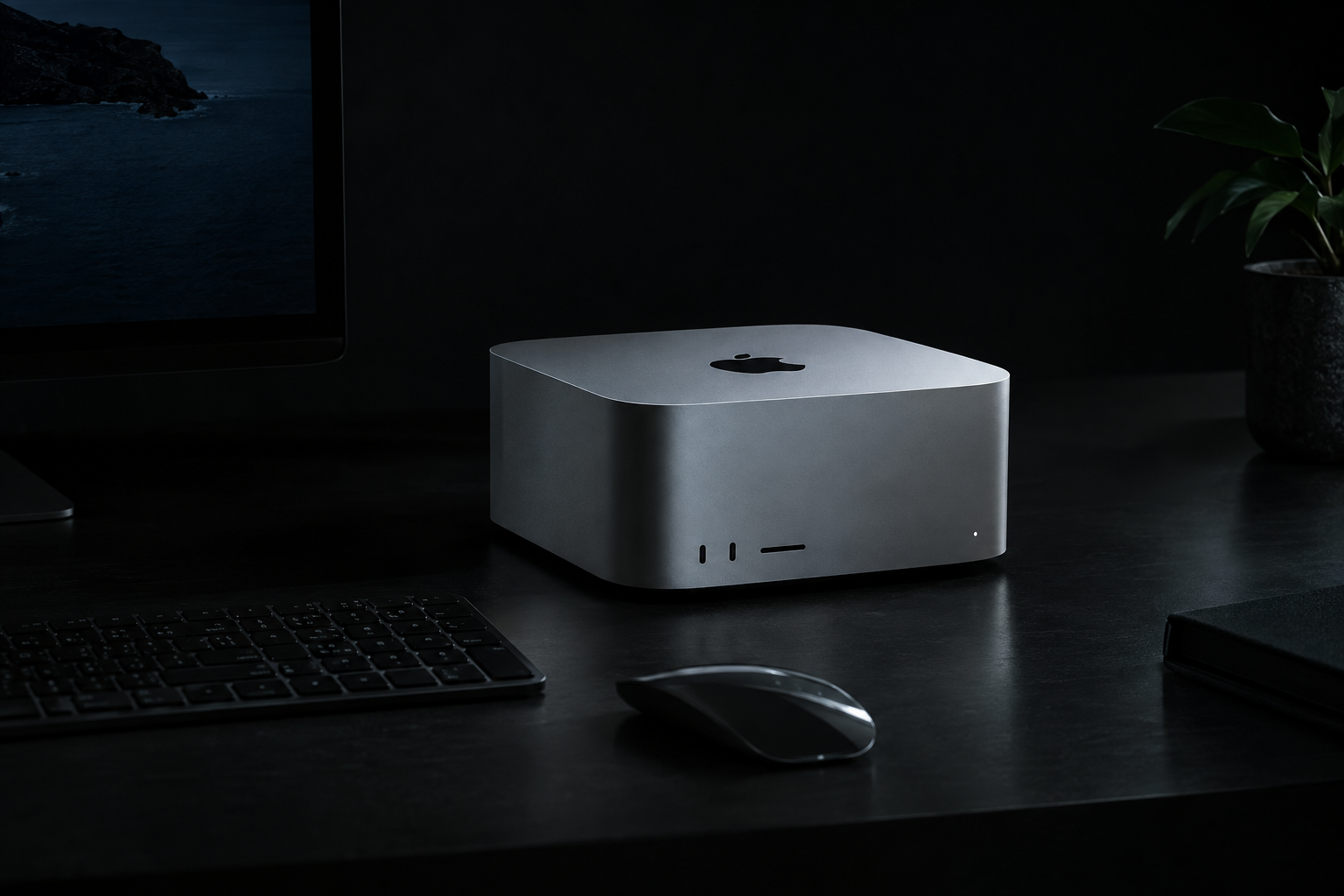
The M5 Ultra Mac Studio started reaching customers on September 22, 2026, and while the headlines are about a new most-powerful Mac, the more interesting story plays out one rung down the ladder. Every time Apple refreshes the top of its desktop line, it quietly resets the value of everything below it — the M1 and M2 Studios, and even the Mac Pro. If you own one of those, the arrival of the M5 Ultra Mac Studio is worth understanding, because it changes what your machine is worth on the used market and to whom.
Apple positioned the update as a generational leap. In its newsroom announcement, the company claimed up to 4.3 times faster AI performance, up to 1.8 times faster graphics, and 50 percent more memory bandwidth than the prior generation, with the M5 Ultra scaling to a 36-core CPU, an 80-core GPU, and up to 512GB of unified memory. As AppleInsider noted, the M5 models succeed the M4 and M3 Studios that came before them.
How a new M5 Ultra Mac Studio ripples down the stack
The mechanism is simple and predictable. A new flagship does not just add a faster option at the top; it pushes every older model down a notch in buyers' minds. The machine that was the aspirational pick becomes the sensible-value pick, and the one below that becomes the budget pick. Demand slides down the stack, and prices follow.
Macworld's buying guide captures the supply side of this directly, noting that as people upgrade, reduced or refurbished previous-generation Studios "may become available" on the secondary market. That is the ripple in one sentence: upgraders sell, secondary supply rises, and the buyers who were priced out of a new Studio go shopping for a used one instead.
The short version: The M5 Ultra Mac Studio doesn't just add a new top end — it slides demand down to older Studios and the Mac Pro. That softens used values for owners and creates bargains for buyers, and the effect is sharpest right after launch.
What it means if you own an M1 or M2 Studio
Here is the good news for owners: an M1 Max or M2 Ultra Studio is still a serious machine, and the used market knows it. These were built for sustained professional workloads, and a two- or three-year-old Studio handles video editing, development, and music production without complaint. The demand for that capability at a used price does not evaporate because a faster model exists — it grows, because more buyers can now reach it.
What does change is the anchor. When the current Studio was the newest thing, your machine was measured against it as "last year's flagship." Now it is measured against a model that is meaningfully faster on paper, and its position in the range has shifted. That tends to ease used values gradually rather than crash them, but the softening is real and it starts at launch. If you have already decided to move on from an older Studio, the window where it is still "the recent one" is the strongest it will be.
The Mac Pro question is more complicated
The ripple reaches the Mac Pro, too, and here it is genuinely awkward for Apple's own lineup. The 2023 Mac Pro runs the M2 Ultra, which the new M5 Ultra now comfortably outruns in raw compute — for a lot of workloads, the far cheaper Studio is simply the faster machine. Macworld even observes that a newer Max chip can beat an older Ultra in some tasks, which tells you how quickly a generation of desktop silicon changes the pecking order.
So why buy or hold a Mac Pro at all? Expandability. As MacRumors lays out in its Mac Pro generations comparison, the 2023 tower keeps its PCIe slots for things like DSP cards, SDI I/O, networking, and internal storage — the reasons studios and facilities buy it. But the same guide is blunt about the trade-offs of the Apple silicon era: memory tops out at 192GB and is not upgradeable, and the tower lost support for external GPUs. If you do not need those PCIe slots, a Studio delivers the compute for far less, which is exactly why used Mac Pro demand narrows to the buyers who specifically need expansion.
The 2019 Intel Mac Pro is in the toughest spot of all. It was the most expandable Mac in decades — user-upgradeable memory up to 1.5TB, replaceable GPUs, eight PCIe slots — but it is also now on the wrong side of the Apple silicon transition. Its raw performance trails modern M-series chips, and its resale audience is increasingly limited to owners who value that legacy expandability. Two forces are pressing on its value at once.
Good for buyers, a timing question for sellers
None of this is bad news, exactly — it just depends which side of the transaction you are on.
- If you are buying: the months after a flagship launch are prime hunting season. Upgraders list their older Studios, secondary supply rises, and a previous-generation machine that is still overkill for most work becomes far more attainable.
- If you are selling: the ripple works against you over time. Your machine's position in the lineup just dropped, and used values tend to drift down as more upgraders list. The strongest moment to sell an older Studio or Mac Pro is generally soonest, before the new-supply wave fully lands.
- If you are holding: that is fine if the machine still does the job. A capable Studio does not get slower because a faster one shipped — just know the resale number is easing while you wait.
Because desktop values move by exact model, chip, memory, and condition, the only reliable way to know where yours sits after this launch is to check a live number rather than guess from a year-old sale you half-remember. An instant offer takes about thirty seconds, and it reflects today's market rather than yesterday's.
The bottom line
The M5 Ultra Mac Studio is a big step up at the top of the range, but its most practical effect for existing owners is the ripple it sends downward. Older Studios remain excellent machines and stay in demand, while the Mac Pro's case narrows to buyers who truly need expansion. For buyers, that spells opportunity; for sellers, it is a reminder that a machine's place in the lineup — and its resale value — resets the day a new flagship ships, and the clock starts then.
Get an instant offer on your Mac
A real number in about 30 seconds — working or not. Free prepaid shipping, no seller fees, paid the day it arrives.*
Get my offerSources
More from Encore
 Market & Pricing
Is There a Best Time of Year to Sell a Mac?
The best time to sell a Mac is set by Apple's refresh cycle and your machine's age, not the season on the calendar.
Sep 27, 2026 · 6 min read
 Market & Pricing
Why the Internet Can't Agree on the MacBook Neo
The MacBook Neo splits reviewers between best budget laptop and just a tablet. The real divide is about which buyer they picture.
Sep 24, 2026 · 6 min read
 Market & Pricing
What Apple's Fall 2026 Lineup Means for the Used Mac Market
Apple's busy fall lineup resets the reference point for every used Mac. Here's how each launch wave moves resale values.
Sep 23, 2026 · 6 min read